Key takeaways
- Seed bags must keep seed dry and let it breathe; fertilizer bags must keep moisture out completely. That one difference drives most design choices.
- Paper-poly and micro-perforated woven bags suit seed; PE-lined or coated woven bags and valve bags suit fertilizer.
- Size from bulk density: 50 lb of alfalfa seed needs about 30 L, 50 lb of fescue about 75 L.
- Use FIBCs for bulk seed and bulk fertilizer above about 500 kg per lot.
Seed bags and fertilizer bags look alike on a pallet, but they solve opposite problems. Seed is alive: it needs dry conditions plus a little air exchange, so seed bags are usually paper-poly, paper or micro-perforated woven sacks. Fertilizer is often hygroscopic — it pulls water from the air and cakes — so fertilizer bags need a near-complete moisture barrier, usually a PE liner or coated woven fabric. Get that distinction right and the rest of the specification follows.
This guide is for seed companies, blenders, co-ops and distributors buying agricultural packaging bags at volume. For a side-by-side of the base materials, see PP woven vs BOPP vs paper-poly.
Agricultural seed bags: what the bag has to do
A good agricultural seed bag:
- Limits moisture uptake. Seed stored humid loses germination quickly; a common rule of thumb is that each 1% rise in seed moisture roughly halves storage life within the normal storage range.
- Allows some gas exchange, especially for seed packed warm or not fully dry, so condensation does not form inside.
- Protects treated seed and the people handling it, with clear warning panels and a dust-tight build.
- Carries a lot of printed information: variety, lot number, germination %, purity, treatment, net weight and regulatory text.
- Stacks squarely on pallets for warehouse and dealer storage.
Paper seed bags vs paper-poly seed bags
| Bag type | Construction | Pros | Cons | Best fit |
|---|---|---|---|---|
| Multiwall paper seed bags | 2–4 kraft plies, sometimes a PE ply | Breathable, prints well, familiar to seed lines | Tears when wet or dropped | Dry warehouse chains, small seed lots |
| Paper-poly (paper-plastic composite) | Kraft paper laminated to woven PP | Paper look with woven strength, stacks well | Higher cost than plain woven | Alfalfa, clover, grass seed, premium cereal seed |
| Micro-perforated BOPP or coated woven | Woven PP with film or coating, small air holes | Tough, moisture-resistant, bright print | Less breathable than paper | Corn, soybean and cereal seed in humid regions |
| Plain woven PP | Uncoated woven fabric | Cheap, breathable, strong | Little moisture protection, basic print | Farm-saved seed, bulk cereal seed |
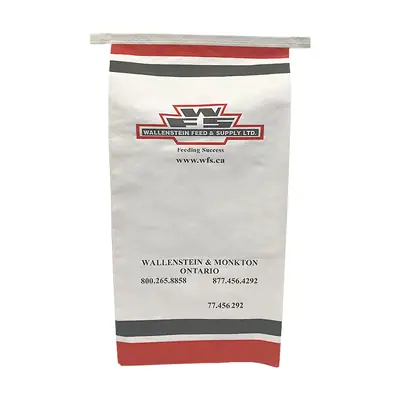
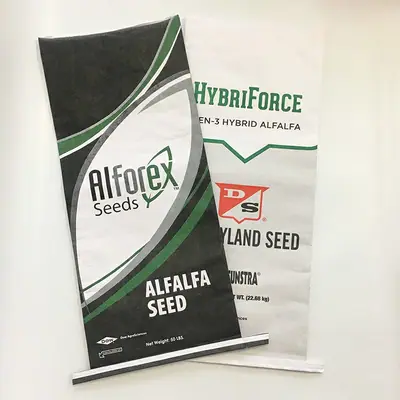
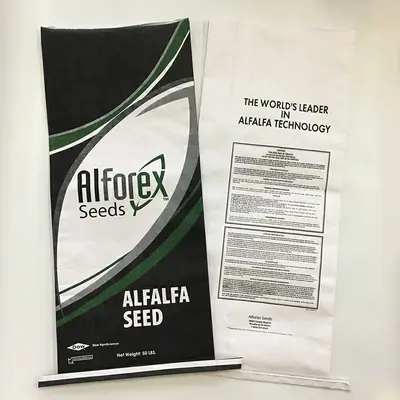
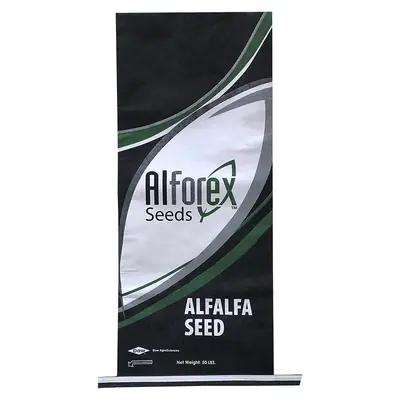
In North America, 50 lb paper-poly bags are common for alfalfa, clover and forage seed. Our Paper Plastic Composite Sewn Side Alfalfa Seed Packaging and Custom Printed Paper-poly Bag PP Woven Lined Kraft Paper are built for that format; the paper-poly seed bags project shows a typical setup.
Small seed bags
Small seed bags — from garden packets up to 1–5 kg retail units — are usually paper envelopes, foil-lined pouches or small BOPP/paper-poly bags. Below about 5 kg, form-fill-seal pouches and printed packets are generally better value than sewn woven sacks. Woven construction becomes the economical choice from roughly 10 kg upward.
Bulk seed bags
For seed sold by the unit or the tonne, bulk seed bags — FIBCs holding roughly 500–1,000 kg — are standard for corn, soybean and cereal seed moving from conditioning plant to dealer or farm. Seed FIBCs usually have a filling spout top, discharge spout bottom and breathable or vented fabric, with clear lot labels in a document pouch. See how to choose an FIBC bulk bag and food-grade bulk bags for build options. Always check the safe working load on the bag's label.
How big should a seed bag be?
Seeds vary enormously in bulk density, so a 50 lb bag of grass seed is much larger than a 50 lb bag of wheat.
Volume (L) = fill weight (kg) ÷ bulk density (kg/L)
| Seed | Approx. test weight | Bulk density | Volume for 50 lb (22.7 kg) | Volume for 25 kg |
|---|---|---|---|---|
| Wheat | 60 lb/bu | 0.77 kg/L | 30 L | 32 L |
| Soybean | 60 lb/bu | 0.77 kg/L | 30 L | 32 L |
| Alfalfa | 60 lb/bu | 0.77 kg/L | 30 L | 32 L |
| Corn (shelled) | 56 lb/bu | 0.72 kg/L | 32 L | 35 L |
| Oats | 32 lb/bu | 0.41 kg/L | 55 L | 61 L |
| Tall fescue | about 20–25 lb/bu | 0.26–0.32 kg/L | 71–87 L | 78–96 L |
(1 US bushel = 35.24 L. Test weights are typical; your lot may differ.)
That is why grass seed bags are often sold as 25 lb or 50 lb in much larger bags, and why grass seed packers often prefer wider bags with gussets for stable stacking.
Fertilizer bags: the moisture problem
Many fertilizers are hygroscopic. Urea, ammonium nitrate, calcium nitrate and many NPK blends absorb moisture from humid air, then cake into hard lumps that block spreaders. Fertilizer bags (or fertiliser bags, in UK spelling) therefore focus on:
- A continuous moisture barrier: a loose or attached LDPE liner, a PE-coated woven body, or BOPP lamination plus liner.
- Sealed closures: heat-sealed liners and sewn outer tops, or valve bags with self-closing sleeves.
- UV stabilisation for bags stored outdoors at depots and farms.
- Anti-slip surfaces because dense fertilizer pallets are heavy and tall.
Plastic fertilizer bag types
| Type | Build | Typical size | Notes |
|---|---|---|---|
| PE-lined woven sack | Woven PP outer + LDPE inner liner | 25 kg, 50 kg | The workhorse for urea, NPK, DAP |
| Coated woven sack | Woven PP + PE coating | 25 kg, 50 kg | Lower cost; less barrier than a liner |
| BOPP laminated + liner | Printed BOPP woven + liner | 10–50 kg | Retail and branded specialty fertilizer |
| Heavy-duty PE FFS bag | Monolayer or coextruded PE film | 25 kg | For automated form-fill-seal lines |
| Woven valve bag | Block-bottom woven PP with valve | 25 kg | Fast filling of powders and granules |
| FIBC with liner | 1 t bulk bag + PE liner | 500–1,000 kg | Blenders, co-ops, bulk spreading |
Our PP Woven Bag with Inner Liner 25kg Capacity Moisture and Durable PP/PE Woven Bags for Rice Fertilizer Feed Storage are typical lined and coated constructions. If you fill on a valve packer, compare formats in valve bags vs open mouth bags.
Fertilizer bulk density and bag size
| Fertilizer | Typical bulk density | Volume for 50 kg | Volume for 25 kg |
|---|---|---|---|
| Urea (prilled/granular) | 0.72–0.77 kg/L | 65–69 L | 32–35 L |
| DAP / MAP | 0.90–1.00 kg/L | 50–56 L | 25–28 L |
| Muriate of potash | 1.00–1.10 kg/L | 45–50 L | 23–25 L |
| NPK compound | 0.95–1.10 kg/L | 45–53 L | 23–26 L |
| Organic pellets | 0.55–0.70 kg/L | 71–91 L | 36–45 L |
Typical 50 kg fertilizer sacks are around 55–60 cm wide by 90–100 cm long; 25 kg sacks around 45–50 × 70–80 cm. Confirm with a fill trial, because granule size and liner fit affect the final size.
Shared requirements for all agricultural bags
Whether you are packing seed, fertilizer, feed or grain, agricultural bags share a few non-negotiables:
- Fabric weight matched to the load. For 50 kg sacks, woven fabric of about 80–100 g/m² is common; 25 kg sacks often use 65–85 g/m². Sharp or very dense products need more.
- Strong bottom seams. Single-fold, double-fold or heat-sealed bottoms, with stitch density matched to the product's fineness.
- UV stabilisation for any bag that may sit outdoors.
- Accurate printing of regulated information: lot, analysis, net weight and safety text.
- Compatibility with your filling line: open mouth, valve, pinch or FFS.
Grain-specific sacks are covered in our grain and rice bags guide, and feed in our feed bags guide.
Buying seed bags and fertilizer bags wholesale
Searching "seed bags for sale" or "plastic fertilizer bags wholesale" turns up everything from garden packets to tonne bags. For commercial volumes, a direct factory quote is usually the most efficient route. Send:
- Product, fill weight and bulk density (or a sample)
- Bag type and dimensions, gusset and fabric weight
- Liner or coating requirement, including liner thickness
- Closure: sewn, heat-sealed, pinch or valve
- Printing: colors, sides and any variable data boxes
- Annual volume per design and target delivery dates
EGP is a manufacturer of woven, paper-poly and laminated agricultural packaging bags in Yantai, Shandong, with 24 years as an Alibaba.com supplier and a 90.9% on-time dispatch record. Browse Paper-Poly Bags and our products, or request a quote via our contact page.
Frequently asked questions
Should seed bags be breathable?
Yes, to a degree. Seed should be packed dry, but a small amount of gas exchange through paper plies or micro-perforations reduces the risk of condensation inside the bag. Fully sealed bags are used for seed that has been dried to low moisture specifically for hermetic storage.
What is the best bag for urea fertilizer?
A woven PP sack with an LDPE inner liner, heat-sealed or tightly tied, is the most common choice for urea because it blocks humid air well. For automated lines, heavy-duty PE form-fill-seal bags are also widely used.
Are paper seed bags strong enough for 50 lb?
Multiwall paper seed bags can hold 50 lb in dry warehouse chains, but they tear more easily when dropped or exposed to moisture. Paper-poly composite bags give the same paper look with woven polypropylene strength.
What size are agricultural bags for 50 kg of fertilizer?
Most 50 kg fertilizer sacks fall around 55–60 cm wide and 90–100 cm long, depending on product density and liner. Dense potash fits a shorter bag; urea and organic pellets need more length.
Can one bag design be used for both seed and fertilizer?
It is possible but rarely ideal. Fertilizer needs a strong moisture barrier, while seed benefits from limited breathability; most suppliers use a lined or coated bag for fertilizer and paper-poly or micro-perforated bags for seed.