Key takeaways
- Standard 8×8×16 in blocks (16×8 in face with a 3/8 in joint) need 1.125 blocks per sq ft, or about 12.5 blocks per m² for metric 390×190 mm blocks.
- Blocks = wall area × blocks per sq ft, then add 5–10% for cuts and breakage.
- A common rule of thumb is about 3 bags (80 lb / 36 kg) of mortar mix per 100 blocks (range roughly 2.5–3.5); always check the yield printed on your bag.
- Type N mortar suits most above-grade walls; Type S is the usual choice for below-grade, retaining and high-load work (ASTM C270).
A wall built from standard 8×8×16 in concrete blocks needs 1.125 blocks per square foot of wall face (about 12.5 blocks per m² for metric 390×190 mm blocks), so multiply the wall's length by its height, multiply by 1.125 and add 5–10% for waste. For mortar, a common rule of thumb is about three 80 lb (36 kg) bags of pre-blended mortar mix per 100 blocks, but real usage ranges from roughly 2.5 to 3.5 bags, so check the yield printed on your bag.
Definition: A concrete block calculator converts the face area of a masonry wall into the number of concrete masonry units (CMU) and the volume or number of bags of mortar needed to lay them.
The rest of this guide shows the formulas, worked examples, the mix ratios behind cement mortar, and how mortar and cement bags are packed. For concrete slabs and footings, see our how much concrete do I need guide or the free concrete bag calculator.
How do I calculate how many concrete blocks I need?
Every cinder block calculator or cement block calculator uses the same three steps:
- Wall area = length × height (ft² or m²). Subtract doors, windows and other openings.
- Blocks = wall area × blocks per unit area for your block's face size.
- Order quantity = blocks × 1.05 to 1.10, to cover cuts, breakage and corners.
Blocks per area depend only on the nominal face of the unit, which includes one mortar joint. An "8×8×16" block actually measures 7-5/8 × 7-5/8 × 15-5/8 in; with a 3/8 in joint it occupies an 8 × 16 in rectangle, which is 128 in², or 0.889 ft². One square foot (144 in²) therefore holds 144 ÷ 128 = 1.125 blocks. The block's width (4, 6, 8, 10 or 12 in) does not change the count, only the weight and the amount of grout if cores are filled.
Quick reference: blocks per square foot and per square meter
| Unit (nominal face) | Actual face size | Blocks per ft² | Blocks per m² |
|---|---|---|---|
| 8×16 in standard CMU (4, 6, 8, 12 in wide) | 7-5/8 × 15-5/8 in | 1.125 | about 12.1 |
| 4×16 in half-high CMU | 3-5/8 × 15-5/8 in | 2.25 | about 24.2 |
| Metric block 390×190 mm, 10 mm joint | 390 × 190 mm | about 1.16 | 12.5 |
| UK block 440×215 mm, 10 mm joint | 440 × 215 mm | about 0.92 | about 9.9 |
| US modular brick (8 × 2-2/3 in nominal) | 7-5/8 × 2-1/4 in | 6.75 | about 72.7 |
| Segmental retaining block, 16×6 in face (example) | varies by maker | 1.5 | about 16.1 |
A normal-weight hollow 8×8×16 block typically weighs about 35–40 lb (16–18 kg); lightweight units are commonly 25–30 lb (11–14 kg). That matters when you order a pallet and plan the lift.
Worked example: a 40 ft garden wall
A wall 40 ft long and 4 ft high has 160 ft² of face. 160 × 1.125 = 180 blocks; with 5% waste, order 189 blocks. In metric, a 12.2 × 1.22 m wall (14.9 m²) at 12.5 blocks/m² also comes to about 186 blocks before waste.
How much mortar per block do I need?
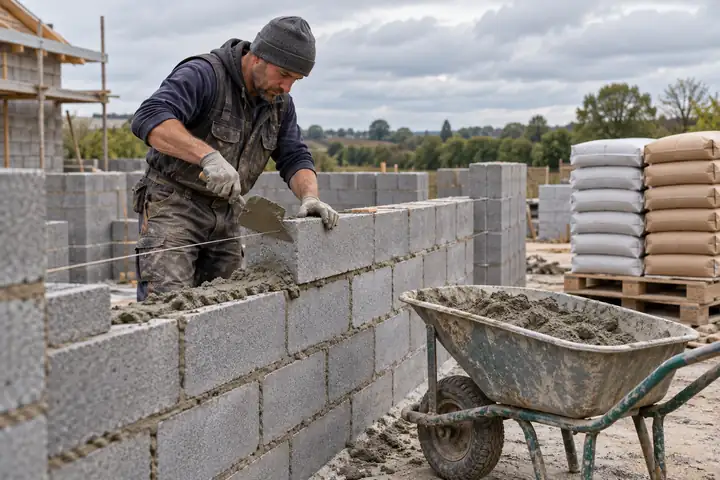
Mortar volume depends on the joint thickness and on whether the mason uses face-shell bedding (mortar only on the two face shells, standard for hollow block) or full bedding (mortar on the webs too, used on the first course and in some structural work).
For face-shell bedding with a 3/8 in (10 mm) joint, the bed joint and head joint of one 8×16 block add up to roughly 22 in³, or about 0.013 ft³ (0.37 L) per block. That is the theoretical minimum. On a real job, droppings, fully buttered head joints and mixing losses push actual usage up by a third or more, which is why the field rule of thumb is higher.
How many bags of mortar per block?
| Method | Mortar per 100 blocks | Notes |
|---|---|---|
| Theoretical, face-shell bedding, 3/8 in joint | about 1.3 ft³ (37 L) | Before any waste |
| Field rule of thumb, pre-blended mortar mix | about 3 × 80 lb (36 kg) bags, range 2.5–3.5 | Most common estimate for 8×8×16 CMU |
| Full bedding (first course, structural) | noticeably more | Estimate that course separately |
For the 189-block wall above, 189 × 3 ÷ 100 = about 5.7, so order 6 bags of 80 lb mortar mix (a realistic range is about 5 to 7). If you are mixing from bagged cement and sand instead, convert the volume using the yield on the cement or masonry cement bag. Bag yields vary by manufacturer and product, so the printed yield always overrides any rule of thumb, including ours.
To answer "how many bags of mortar per 100 block" quickly: three 80 lb bags of mortar mix is the usual starting figure, or roughly four 60 lb bags.
Retaining wall block calculator: what changes?
Segmental retaining wall units are dry-stacked and usually need no mortar, but their face sizes vary widely by manufacturer. Use the general formula:
Blocks per ft² = 144 ÷ (face length in × face height in)
A unit with a 16 × 6 in face gives 144 ÷ 96 = 1.5 blocks per ft², so a wall 30 ft long and 2 ft high (60 ft²) needs 90 blocks, or about 95 with 5% extra. Add the buried base course: most retaining wall systems bury the first course, so include it in the height. Cap units are counted by length (wall length ÷ cap length).
For a round fire pit, blocks per course = π × centerline diameter ÷ block face length. A 48 in inside diameter with 12 in deep blocks has a 60 in centerline, so π × 60 ÷ 16 ≈ 11.8, or 12 tapered blocks per course.
Retaining wall base gravel and backfill are bulk materials; our sand calculator guide covers the volume-to-tons conversion.
Type N vs Type S mortar: which should I use?
Mortar types are defined in ASTM C270. The standard allows mortar to be specified either by proportions or by properties; the minimum 28-day compressive strengths in the property specification are commonly quoted as follows.
| Mortar type | Typical proportion (portland cement : lime : sand, by volume) | Property-spec minimum strength | Typical use |
|---|---|---|---|
| Type M | 1 : 1/4 : about 3-3/4 | 2,500 psi (17.2 MPa) | Below grade, foundations, heavy loads |
| Type S | 1 : 1/2 : about 4-1/2 | 1,800 psi (12.4 MPa) | Retaining walls, below grade, high wind or seismic areas |
| Type N | 1 : 1 : about 6 | 750 psi (5.2 MPa) | General above-grade block and brick walls |
| Type O | 1 : 2 : about 9 | 350 psi (2.4 MPa) | Interior, non-load-bearing, repointing soft brick |
In the proportion method, the sand volume is typically 2-1/4 to 3 times the total volume of cementitious material. Stronger is not automatically better: a mortar much harder than the block can crack the units instead of the joint. Follow the project specification or local code.
Cement mortar mix vs concrete mix ratio
People often search for "concrete mortar" or a single "mix ratio cement" figure, but mortar and concrete are different materials:
- Mortar = cement (often with lime) + sand + water. No coarse aggregate. It bonds units together. A simple site sand and cement mix for blockwork is commonly about 1 part cement to 3–4 parts sand, with lime or a plasticizer for workability; for Type N/S designs, see the table above.
- Concrete = cement + sand + gravel + water. A common general-purpose concrete cement mix ratio is 1 : 2 : 3 (cement : sand : gravel) by volume; 1 : 2 : 4 is often used for footings and 1 : 1.5 : 3 for stronger work. These mixing concrete proportions are approximations; engineered mixes are designed by weight.
- Masonry cement and mortar cement are factory blends of portland cement with lime or other plasticizing materials, sold for mortar only. Portland cement for mortar is used with hydrated lime on site. Our portland cement guide explains the difference.
Stucco calculator: how much material per square foot?
Stucco volume = area × total thickness. Traditional three-coat stucco is about 7/8 in thick, so 100 ft² needs 100 × 0.875 ÷ 12 ≈ 7.3 ft³ of material before waste. In metric, 10 m² at 22 mm is 0.22 m³. Scratch and brown coats are commonly mixed at about 1 part cement to 3–4 parts sand with lime, but follow the bag or the specification you are working to (ASTM C926 covers portland cement-based plaster application in the US). Add 10–15% for waste on textured finishes.
What are mortar bags made of, and why does it matter?
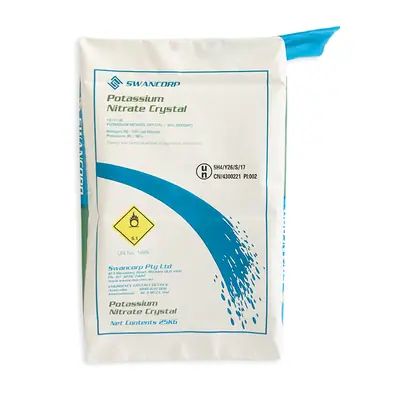
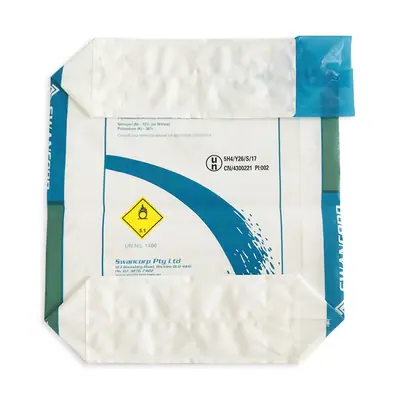
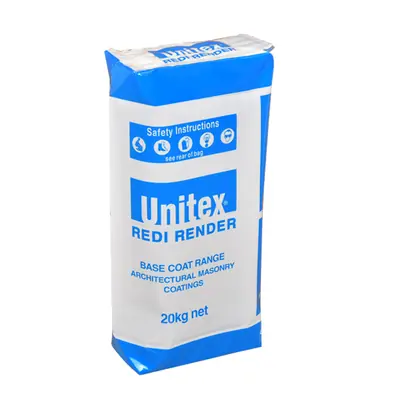
A bag of mortar mix is one of the hardest things to pack: it is a fine, abrasive, moisture-sensitive powder filled at speed and stacked high on pallets. That is why most masonry mortar bags and cement bags are valve bags, filled through a small sleeve by a packing machine and closed by the product's own pressure.
- Multiwall paper sacks breathe well during filling and are the traditional choice.
- Laminated woven polypropylene block-bottom valve bags, like our Custom Logo Square Bottom Laminated PP Woven Waterproof, resist tearing and rain on open jobsites and stack as neat bricks.
- Heavy-duty PP valve bags such as the Heavy Duty PP Valve Bag 45kg Virgin PP Anti-Slip add an anti-slip surface for tall pallet stacks.
- Paper-poly hybrids such as the Moisture-Proof Kraft Paper Valve Bag 35kg Block Bottom combine a kraft look with a moisture barrier.
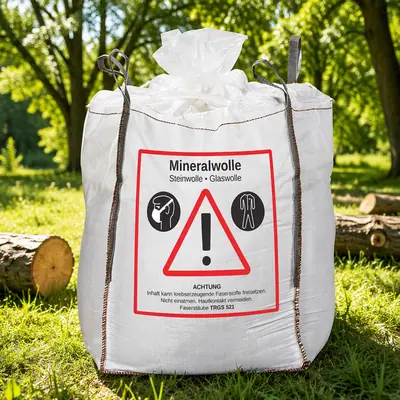
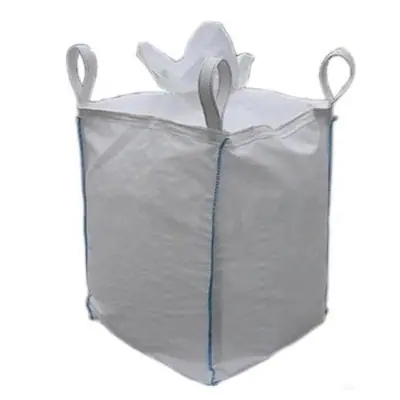
Producers who supply sand or cement to block plants in bulk often use 1-tonne bulk bags instead. Compare sack styles in our cement bag types guide and browse our Valve Bags range.
Need mortar or cement bags for your plant?
Yantai Evergreen Packaging manufactures valve bags, woven sacks and FIBC bulk bags in Yantai, China, for mortar, cement and building-materials producers and distributors. We make custom sizes and printed designs to your fill weight and packing machine. Send your bag size, fill weight and artwork through our contact page for a quote.
Frequently asked questions
How many blocks are in 100 square feet of wall?
With standard 8×16 in face blocks, 100 ft² × 1.125 = 112.5, so about 113 blocks before waste, or roughly 118–124 blocks with 5–10% added. Half-high 4×16 in blocks double that to 225.
How many bags of mortar do I need for 100 blocks?
A common rule of thumb is about three 80 lb (36 kg) bags of pre-blended mortar mix per 100 standard 8×8×16 blocks, with a realistic range of 2.5–3.5 bags. Joint thickness, full versus face-shell bedding and waste change the figure, so check the yield on your bag.
Is Type S or Type N mortar stronger?
Type S is stronger: ASTM C270's property specification gives minimum compressive strengths of 1,800 psi for Type S and 750 psi for Type N. Type N is the usual choice for above-grade walls, while Type S is used for retaining walls, below-grade work and higher structural demands.
Can I use concrete mix instead of mortar mix to lay blocks?
No. Concrete mix contains gravel, which makes it too coarse to form thin, uniform joints, and it lacks the lime or plasticizers that give mortar its workability and bond. Use a mortar mix or a mortar made from masonry cement and sand.
What is the mix ratio for cement mortar?
For general blockwork, a sand and cement mix of about 1 part cement to 3–4 parts sand, with lime or a plasticizer, is common. For specified Type N or Type S mortar, use the ASTM C270 proportions, such as 1 : 1 : 6 or 1 : 1/2 : 4-1/2 portland cement, lime and sand.