Key takeaways
- Tube volume (cu ft) = 0.7854 × diameter² × depth, with diameter and depth in feet.
- Per foot of depth: 8 in tube ≈ 0.35 cu ft, 10 in ≈ 0.55, 12 in ≈ 0.79; a 12 in × 4 ft tube needs about 6 × 80 lb bags.
- Deck footing area = load ÷ soil bearing capacity; common code assumptions are 50 psf deck load and 1,500 psf soil.
- Footings typically go below the local frost line and at least 12 in below undisturbed ground; check local code.
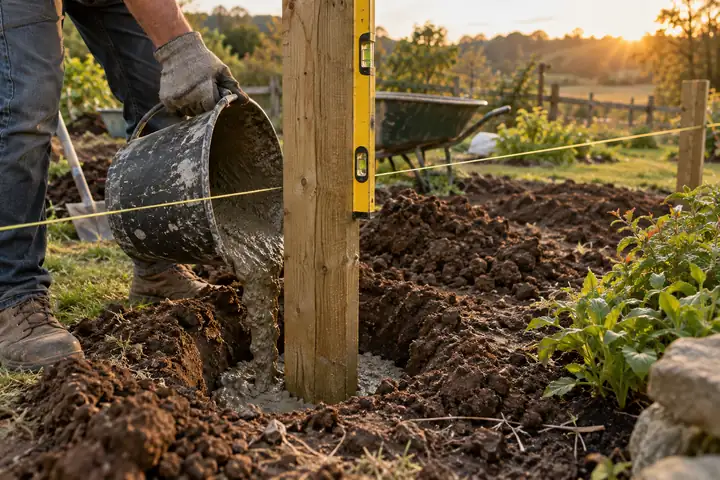
- A 4x4 fence post in a 10 × 30 in hole takes about 1.15 cu ft: 2 × 80 lb or 4 × 50 lb bags.
To calculate concrete for a sonotube (Sonotube is a trade name commonly used for round cardboard concrete form tubes), square the diameter in feet, multiply by 0.7854 and by the depth in feet: the result is cubic feet. A 12 in (1 ft) tube 4 ft deep holds 0.7854 × 1 × 4 = 3.14 cu ft, which is about six 80 lb bags of premixed concrete at a typical 0.60 cu ft per bag; a 10 in tube of the same depth holds 2.18 cu ft, about four bags. Size the footing itself from the load and your soil, and set it below the local frost depth.
Skip the maths: our free concrete bag calculator converts post holes and footings into cubic yards and 40–90 lb or 25 kg bags.
Key formula: Form tube concrete (cu ft) = 0.7854 × diameter (ft)² × depth (ft). Metric: m³ = 0.7854 × diameter (m)² × depth (m). Bags = cu ft ÷ bag yield (about 0.60 cu ft for 80 lb, 0.45 for 60 lb, 0.375 for 50 lb).
0.7854 is π ÷ 4, the factor that turns a diameter squared into the area of a circle. All numbers below are typical; footing sizes and depths are set by your local building code, the deck or building design, and, where required, an engineer.
How much concrete does a sonotube need?
| Tube diameter | Cu ft per ft of depth | Litres per m of depth | 4 ft (1.22 m) tube: cu ft | 80 lb bags | 60 lb bags | 50 lb bags |
|---|---|---|---|---|---|---|
| 6 in (150 mm) | 0.196 | 18 | 0.79 | 2 | 2 | 3 |
| 8 in (200 mm) | 0.349 | 32 | 1.40 | 3 | 4 | 4 |
| 10 in (250 mm) | 0.545 | 51 | 2.18 | 4 | 5 | 6 |
| 12 in (300 mm) | 0.785 | 73 | 3.14 | 6 | 7 | 9 |
| 14 in (350 mm) | 1.069 | 99 | 4.28 | 8 | 10 | 12 |
| 16 in (400 mm) | 1.396 | 130 | 5.59 | 10 | 13 | 15 |
| 18 in (450 mm) | 1.767 | 164 | 7.07 | 12 | 16 | 19 |
| 24 in (600 mm) | 3.142 | 292 | 12.57 | 21 | 28 | 34 |
Bag counts are rounded up per tube, before waste, using typical yields. Read the yield on your own bag, because mixes vary.
For a different depth, multiply the "per ft" column by the depth in feet. Example — 12 in form tube, 42 in deep: 0.785 × 3.5 = 2.75 cu ft, which is 4.6 → 5 × 80 lb bags, or 7 × 60 lb bags.
Worked example: deck footing calculator
Deck footings are sized so the soil under them is not overloaded.
Footing area (sq ft) = load on the post (lb) ÷ allowable soil bearing (psf)
Many US residential codes assume a deck load of 40 psf live + 10 psf dead = 50 psf and, without a soil test, a presumptive soil bearing capacity of 1,500 psf. Your local values may differ.
Example: posts 8 ft apart along a beam that supports joists spanning 12 ft. Each post carries half the joist span (6 ft) × the post spacing (8 ft) = 48 sq ft of deck.
- Load = 48 × 50 = 2,400 lb (about 1,090 kg)
- Required area = 2,400 ÷ 1,500 = 1.6 sq ft (0.149 m²)
- Round footing diameter = √(1.6 ÷ 0.7854) = 1.43 ft = 17.1 in → use an 18 in round (1.77 sq ft) or a 16 × 16 in square (1.78 sq ft) footing
The bearing area is at the bottom: a 10 in tube sitting on an 18 in spread footing or a flared footing base carries far more than a plain 10 in tube. For six such piers made of 10 in tubes 42 in deep: 0.545 × 3.5 × 6 = 11.45 cu ft, about 20 × 80 lb bags, or 21 with 10% extra, plus the concrete in any pads.
Pier with pad: a 24 × 24 × 8 in pad (2.67 cu ft) plus a 10 in tube 36 in tall (1.64 cu ft) is 4.30 cu ft, about 8 × 80 lb bags per pier.
Deck footing sizing chart (typical)
| Deck area carried by the post | Load at 50 psf | Area at 1,500 psf soil | Round footing | Square footing |
|---|---|---|---|---|
| 24 sq ft | 1,200 lb | 0.8 sq ft | 14 in | 12 × 12 in |
| 36 sq ft | 1,800 lb | 1.2 sq ft | 16 in | 14 × 14 in |
| 48 sq ft | 2,400 lb | 1.6 sq ft | 18 in | 16 × 16 in |
| 64 sq ft | 3,200 lb | 2.13 sq ft | 20 in | 18 × 18 in |
| 80 sq ft | 4,000 lb | 2.67 sq ft | 24 in | 20 × 20 in |
Sizes rounded up to common dimensions. Footing thickness for spread pads is commonly at least 6–8 in; check your local deck guide.
Concrete footing size rule of thumb
For continuous wall footings under light-frame walls, a long-standing rule of thumb is: footing width about twice the wall thickness, footing thickness about equal to the wall thickness. US residential codes commonly set minimums of about 12 in wide and 6 in thick, with wider footings for more stories or weaker soil.
| Foundation wall | Rule-of-thumb footing (width × thickness) | Concrete per 10 ft of footing |
|---|---|---|
| 6 in (150 mm) | 12 × 6 in (300 × 150 mm) | 5.0 cu ft (0.19 yd³) |
| 8 in (200 mm) | 16 × 8 in (400 × 200 mm) | 8.9 cu ft (0.33 yd³) |
| 10 in (250 mm) | 20 × 10 in (500 × 250 mm) | 13.9 cu ft (0.51 yd³) |
| 12 in (300 mm) | 24 × 12 in (600 × 300 mm) | 20.0 cu ft (0.74 yd³) |
Treat this footing size chart as a starting point for estimating, not a design. Actual footing dimensions depend on the building, soil bearing capacity and code tables.
Wall footing example: 40 ft of footing, 16 in wide × 8 in thick (12.2 m × 0.41 m × 0.20 m): 40 × 1.333 × 0.667 = 35.6 cu ft = 1.32 yd³ (1.0 m³). Add 10% → about 1.45 yd³. That is around 60–65 × 80 lb bags, so a ready-mix delivery is usually the better choice; see how much concrete do I need for ordering ready-mix.
How deep should footings be?
Footing depth is set by two things:
- Frost depth. The bottom of the footing typically has to sit below the local frost line so freezing soil cannot heave it. In the US this ranges from a few inches in warm southern areas to 48 in or more in the northern states. Your building department publishes the local figure.
- Undisturbed soil. Codes commonly require footings to bear on undisturbed soil at least 12 in (300 mm) below grade, even where frost is not a factor.
Deeper is not automatically better: a deep, narrow tube with no spread base still bears only on its small bottom area.
How much concrete per fence post?
Fence posts use the same round-hole formula, minus the post itself. Our bags of concrete guide has a full table; the common cases are:
| Hole (diameter × concrete depth) | Post | Concrete | 80 lb | 60 lb | 50 lb |
|---|---|---|---|---|---|
| 8 × 24 in | 4x4 | 0.53 cu ft | 1 | 2 | 2 |
| 10 × 24 in | 4x4 | 0.92 cu ft | 2 | 3 | 3 |
| 10 × 30 in | 4x4 | 1.15 cu ft | 2 | 3 | 4 |
| 12 × 36 in | 6x6 | 1.73 cu ft | 3 | 4 | 5 |
So the answer to how many 50 lb bags of concrete per fence post is typically 3–4 for a 4x4 in a 10 in hole. In weight, a 10 × 30 in hole takes about 150 lb of dry premix per post.
Setting posts in concrete
- Dig the hole about three times the post width across and typically one-third to one-half of the above-ground height deep, or below frost depth where required.
- Put 4–6 in of gravel in the bottom for drainage.
- Brace the post plumb, fill with concrete and slope the top away from the post so water runs off.
Fence post cement mix: use premixed concrete or a fast-setting post mix, not straight cement or mortar. If you mix your own, a common general-purpose ratio is about 1 part cement : 2 parts sand : 3 parts gravel by volume. Concrete fence posts (precast posts used with panel fencing) are typically set with roughly a quarter of their length in the ground and calculated the same way.
Bags for concrete and post-mix producers
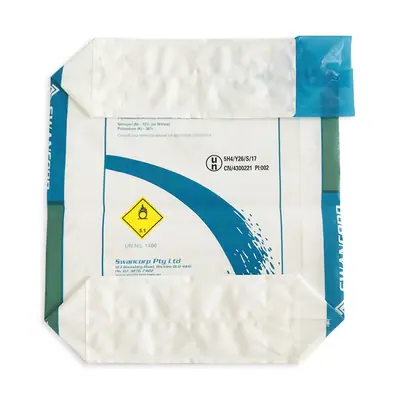
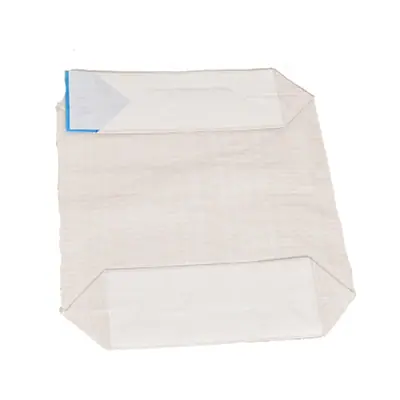
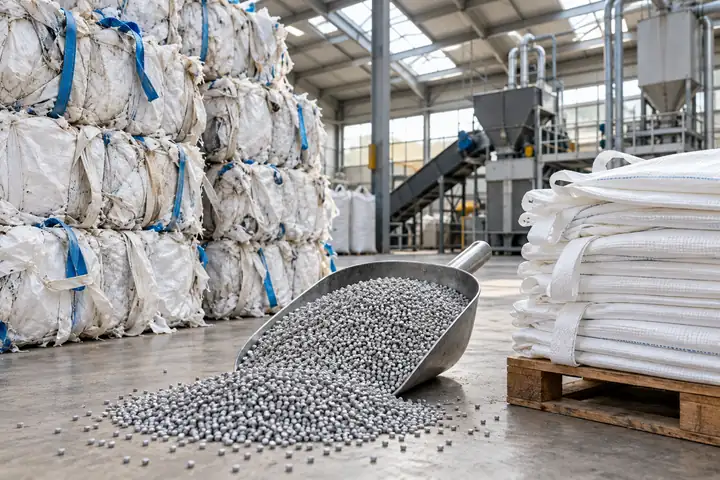
Post mix, premix and cement are heavy, dusty and often stored outdoors. EGP manufactures valve bags that fill cleanly and stack well, such as the Custom Logo Square Bottom Laminated PP Woven Waterproof, the Handmade PP Laminated Kraft Paper Valve Bag 50kg and the Heavy Duty PP Valve Bag 45kg Virgin PP Anti-Slip for anti-slip pallet stacks. See Valve Bags and our guide to concrete bag weights, sizes and pallets. We are a factory in Yantai, Shandong, with a 4.9/5 Alibaba.com store rating; send your bag size and print via our contact page.
Frequently asked questions
How many bags of concrete for a 12 inch sonotube?
A 12 in form tube holds about 0.785 cu ft per foot of depth. A 4 ft tube needs 3.14 cu ft: about six 80 lb bags, seven 60 lb bags or nine 50 lb bags at typical yields.
What size footing do I need for a deck post?
Divide the load on the post by the soil bearing capacity. With a typical 50 psf deck load and 1,500 psf soil, a post carrying 48 sq ft of deck needs about 1.6 sq ft of footing: an 18 in round or 16 × 16 in square pad. Confirm with your local deck code.
How deep should concrete footings be?
Typically below the local frost line and at least 12 in below undisturbed ground. Frost depth varies from a few inches to 48 in or more across the US, so check with your building department.
How many 50 lb bags of concrete per fence post?
For a 4x4 post in a 10 in hole with 30 in of concrete, about four 50 lb bags (1.15 cu ft). An 8 in hole 24 in deep needs about two.
What is the concrete footing size rule of thumb?
A traditional rule is footing width about twice the wall thickness and footing thickness about equal to the wall thickness, so an 8 in wall sits on a 16 × 8 in footing. Codes commonly require at least 12 in wide and 6 in thick; follow local code.
Can I use a form tube without a footing pad?
You can for light loads where the tube's bottom area is enough for the soil, but a plain 10 in tube bears only about 0.55 sq ft. Most deck piers use a wider spread footing or flared base under the tube; check your design.