Key takeaways
- Bags = volume (cu ft) ÷ bag yield (cu ft), rounded up, plus 5–10% for waste.
- Typical yields: 40 lb ≈ 0.30, 50 lb ≈ 0.375, 60 lb ≈ 0.45, 80 lb ≈ 0.60, 90 lb ≈ 0.675 cu ft.
- One cubic yard (27 cu ft) takes about 45 × 80 lb, 60 × 60 lb or 90 × 40 lb bags.
- A typical 4x4 fence post in a 10 in × 30 in hole needs about 2 × 80 lb or 3 × 60 lb bags.
- Always confirm with the yield printed on your bag — it varies by mix and plant.
To work out how many bags of concrete you need, calculate the volume of the pour in cubic feet and divide it by the yield of one bag: an 80 lb bag of premixed concrete typically makes about 0.60 cu ft, a 60 lb bag about 0.45 cu ft and a 40 lb bag about 0.30 cu ft. Round up and add 5–10% for waste. A 10 × 10 ft slab 4 in thick (33.3 cu ft) therefore needs about 56 × 80 lb bags before waste, or roughly 62 with a 10% allowance.
Skip the maths: our free concrete bag calculator does this calculation for you in seconds.
The rest of this guide gives you the formulas, ready-made tables for slabs, fence posts and mailbox posts, and the numbers for mortar. Yields below are typical industry figures; always check the yield printed on your bag, because it differs between mixes (standard, high-strength, fast-setting) and between plants.
How do I calculate how many bags of concrete I need?
Every concrete bag calculator uses the same two steps.
Step 1 – Volume. For a rectangular slab, footing or path:
Volume (cu ft) = length (ft) × width (ft) × thickness (in) ÷ 12
For a round post hole, with all dimensions in inches:
Volume (cu ft) = (0.7854 × hole diameter² − post area) × concrete depth ÷ 1,728
(0.7854 is π ÷ 4; 1,728 is the number of cubic inches in a cubic foot. For a square 4x4 post the actual size is 3.5 × 3.5 in, so the post area is 12.25 sq in; a 6x6 is 5.5 × 5.5 in = 30.25 sq in.)
Step 2 – Bags.
Bags = volume (cu ft) ÷ bag yield (cu ft), rounded up, × 1.05 to 1.10 for waste
If you think in cubic yards, remember that 1 cubic yard = 27 cubic feet, so divide cubic feet by 27 to get yards.
Bag yields: how many cubic feet in a 40, 60, 80 or 90 lb bag?
| Bag size | Typical yield (cu ft) | Typical yield (litres) | Bags per cubic yard (27 cu ft) | Bags per m³ (approx.) |
|---|---|---|---|---|
| 40 lb (18.1 kg) | 0.30 | 8.5 | 90 | 118 |
| 50 lb (22.7 kg) | 0.375 | 10.6 | 72 | 94 |
| 60 lb (27.2 kg) | 0.45 | 12.7 | 60 | 79 |
| 80 lb (36.3 kg) | 0.60 | 17.0 | 45 | 59 |
| 90 lb (40.8 kg) | 0.675 | 19.1 | 40 | 53 |
The pattern is simple: standard premixed concrete yields roughly 0.0075 cu ft per pound, so yield scales with weight. A 60 lb bag of concrete is about 0.45 cubic feet, a 40 lb bag of concrete about 0.30 cubic feet, and a 90 lb bag of concrete about 0.675 cubic feet. Lightweight, fiber-reinforced and fast-setting products can differ, which is why the number on the bag wins over any table.
Outside the US, premix is sold by the kilogram. A 25 kg bag of standard premix typically yields around 11.5–12 litres (about 0.012 m³), but read the bag — metric products vary more between countries than US ones.
How many bags of concrete are in a yard?
Divide 27 by the yield:
- 80 lb bags: 27 ÷ 0.60 = 45 bags
- 60 lb bags: 27 ÷ 0.45 = 60 bags
- 40 lb bags: 27 ÷ 0.30 = 90 bags
- 90 lb bags: 27 ÷ 0.675 = 40 bags
So the answer to "how many 80 lb bags of concrete in a yard" is 45, or about 48–50 once you allow for waste. That is roughly 3,600 lb of material, about 1.6 tonnes, to mix by hand or in a small mixer. Around one cubic yard and above, many contractors switch to ready-mix delivery or a towable mixer; below about half a yard, bags are usually the practical choice.
Worked examples for slabs and paths
| Project | Dimensions | Volume | 80 lb bags | 60 lb bags | 40 lb bags |
|---|---|---|---|---|---|
| Small pad (AC unit, trash cans) | 4 × 4 ft × 4 in | 5.33 cu ft (0.20 yd³) | 9 | 12 | 18 |
| Shed or patio slab | 10 × 10 ft × 4 in | 33.3 cu ft (1.23 yd³) | 56 | 75 | 112 |
| Garden path | 3 × 30 ft × 4 in | 30.0 cu ft (1.11 yd³) | 50 | 67 | 100 |
| Larger patio | 12 × 12 ft × 4 in | 48.0 cu ft (1.78 yd³) | 80 | 107 | 160 |
Counts are rounded up before waste.
Example 1 – 10 × 10 ft patio, 4 in thick, 80 lb bags
- Volume = 10 × 10 × 4 ÷ 12 = 33.33 cu ft (33.33 ÷ 27 = 1.23 yd³)
- Bags = 33.33 ÷ 0.60 = 55.6 → 56 bags
- With 10% waste: 55.6 × 1.10 = 61.1 → 62 bags
The same slab with 60 lb bags: 33.33 ÷ 0.45 = 74.1 → 75 bags, or 82 with 10% waste.
Example 2 – Metric slab, 3 × 3 m, 100 mm thick, 25 kg bags
- Volume = 3 × 3 × 0.10 = 0.90 m³
- If your bag states 11.7 litres (0.0117 m³): 0.90 ÷ 0.0117 = 76.9 → 77 bags
- With 10% waste: 85 bags
Thickness matters more than people expect: going from 4 in to 6 in adds 50% more concrete. Measure depth in several places, especially over uneven gravel.
How many bags of concrete per fence post?
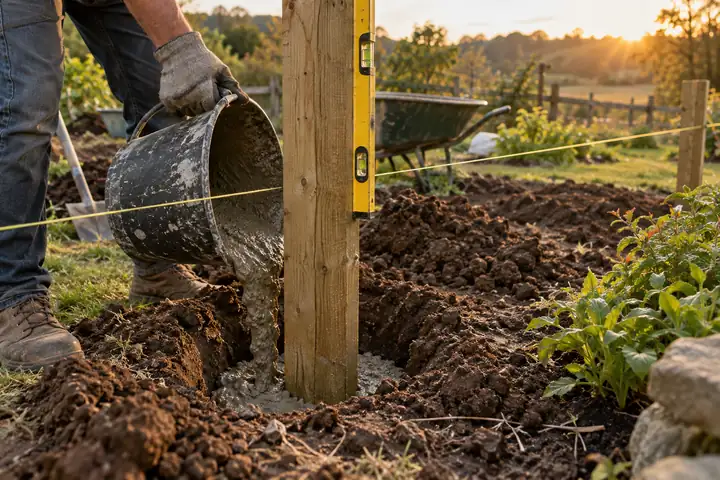
Post holes are where most people over- or under-buy. The concrete volume is the hole minus the post, and only for the depth you actually fill with concrete (many builders put 4–6 in of gravel in the bottom for drainage).
| Hole (diameter × concrete depth) | Post | Concrete (cu ft) | 80 lb | 60 lb | 50 lb | 40 lb |
|---|---|---|---|---|---|---|
| 8 in × 24 in | 4x4 | 0.53 | 1 | 2 | 2 | 2 |
| 10 in × 30 in | 4x4 | 1.15 | 2 | 3 | 4 | 4 |
| 10 in × 36 in | 4x4 | 1.38 | 3 | 4 | 4 | 5 |
| 12 in × 36 in | 6x6 | 1.73 | 3 | 4 | 5 | 6 |
| 12 in × 42 in | 6x6 | 2.01 | 4 | 5 | 6 | 7 |
All values rounded up to whole bags per post.
Example 3 – Fence post, 10 in hole, 36 in deep, 6 in gravel, 4x4 post
- Concrete depth = 36 − 6 = 30 in
- Hole area = 0.7854 × 10² = 78.54 sq in; minus post 12.25 sq in = 66.29 sq in
- Volume = 66.29 × 30 ÷ 1,728 = 1.15 cu ft
- 80 lb bags: 1.15 ÷ 0.60 = 1.92 → 2 bags; 60 lb bags: 1.15 ÷ 0.45 = 2.56 → 3 bags
For a run of 20 posts that is 40 × 80 lb bags, close to one full pallet. A common rule of thumb is a hole diameter about three times the post width and a depth of one-third to one-half of the above-ground height, but follow local frost-depth rules and any engineering drawings.
How many bags of concrete for a mailbox post?
A mailbox post is a small, shallow fence post. For a 4x4 set in an 8 in hole with 24 in of concrete:
- Hole area = 0.7854 × 8² = 50.27 sq in; minus 12.25 sq in = 38.02 sq in
- Volume = 38.02 × 24 ÷ 1,728 = 0.53 cu ft
- 80 lb: 0.88 → 1 bag; 60 lb: 1.17 → 2 bags; 50 lb: 1.41 → 2 bags; 40 lb: 1.76 → 2 bags
So one 80 lb bag or two 50/60 lb bags is the usual answer for bags of concrete for a mailbox post. Fast-setting post mixes often have a slightly different yield; check the bag. Whether you can pour them dry and add water is covered in our guide to concrete bag weights, water and pallets.
How many bags of mortar per 100 block?
Mortar is estimated per unit laid, not per cubic foot of wall. For standard 8 × 8 × 16 in concrete masonry units with 3/8 in joints, industry estimates typically fall in the range of about 6 to 8.5 cu ft of mortar per 100 blocks, depending on whether only the face shells or the full webs are bedded, plus waste.
| Mortar product | Typical yield | Approx. bags per 100 blocks (8 × 8 × 16) |
|---|---|---|
| Pre-blended mortar mix, 80 lb | about 0.6–0.7 cu ft (check bag) | about 8–13 |
| Masonry cement, typically 70–75 lb, mixed about 1 : 3 with sand | about 3 cu ft of mortar per bag with sand | about 2.5–3, plus roughly 7–9 cu ft (0.25–0.33 yd³) of mason sand |
Worked check: 7 cu ft of mortar ÷ 0.65 cu ft per 80 lb bag = 10.8 → about 11 bags of pre-blended mortar per 100 block. Bricks use far less mortar per unit but far more units per square foot, so estimate them separately. Mortar types, bag weights and the difference between masonry cement and mortar mix are explained in our concrete bag weights guide.
Common mistakes when using a concrete bag calculator
- Using nominal post sizes. A 4x4 is 3.5 × 3.5 in; using 4 × 4 slightly underestimates the concrete.
- Forgetting the gravel layer in post holes, which overstates the concrete.
- Mixing cubic feet and cubic yards. Divide by 27, not by 9 or 3.
- Assuming every 80 lb bag yields 0.60 cu ft. High-strength, fiber and fast-set products can yield differently.
- Skipping the waste factor. Uneven subgrade, form bulges and spillage easily consume 5–10%.
- Adding extra water to stretch a bag. More water increases slump, not yield in any useful sense, and it weakens the concrete.
For producers and distributors of bagged concrete
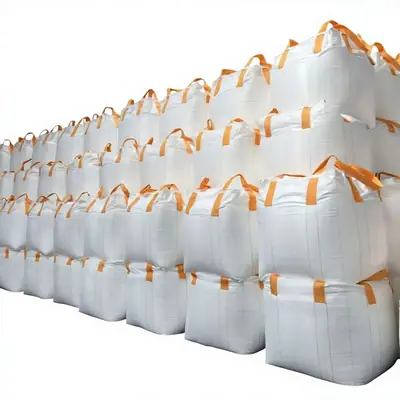
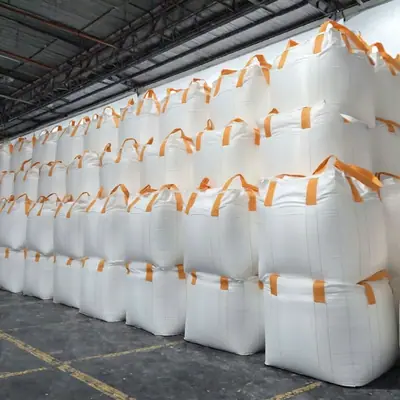
If you blend and pack concrete, mortar or cement, every figure above depends on a bag that holds its weight, breathes out air during filling and survives pallet stacking and outdoor storage. EGP manufactures woven polypropylene and paper-laminated valve sacks for this market, including the Custom Logo Square Bottom Laminated PP Woven Waterproof and the Handmade PP Laminated Kraft Paper Valve Bag 50kg, plus FIBC bulk bags such as the Super Sack PP Woven Flat Bottom Jumbo FIBC Bag Cement for cement and aggregates moved by the tonne. See the full Valve Bags range, read our cement bag types guide to compare paper and woven sacks, and compare valve bags and open-mouth bags for your filling line.
We are a factory in Yantai, Shandong, with 24 years as an Alibaba.com supplier and an average response time of 8 hours or less. Send your fill weight, bag dimensions and print artwork via our contact page for a quotation.
Frequently asked questions
How many 80 lb bags of concrete do I need for a 10x10 slab?
At 4 in thick a 10 × 10 ft slab is 33.3 cu ft, so you need 33.3 ÷ 0.60 = 56 bags of 80 lb premix, or about 62 with a 10% waste allowance. At 6 in thick the volume rises to 50 cu ft, or 84 bags before waste.
How many cubic feet is a 60 lb bag of concrete?
A 60 lb bag of standard premixed concrete typically yields about 0.45 cu ft, so 60 bags make one cubic yard. Fast-setting and high-strength mixes may yield slightly differently, so use the figure printed on your bag.
How many 40 lb bags of concrete make a yard?
About 90, because a 40 lb bag yields roughly 0.30 cu ft and a cubic yard is 27 cu ft. At that quantity, 80 lb bags (45 per yard) or ready-mix are usually far less work.
How many bags of concrete per fence post do I need?
For a common 4x4 post in a 10 in hole with 30 in of concrete, you need about 1.15 cu ft: two 80 lb bags or three 60 lb bags. Larger 6x6 posts in 12 in holes typically need three to four 80 lb bags each.
Is a 90 lb bag of concrete worth it?
A 90 lb bag yields about 0.675 cu ft, so 40 bags make a yard instead of 45 with 80 lb bags, which means fewer bags to open. The trade-off is handling: 90 lb is heavy to lift repeatedly, and many crews prefer 60–80 lb bags for safety.
How many 60 lb bags of concrete are in a yard?
About 60. A cubic yard is 27 cu ft and a 60 lb bag yields roughly 0.45 cu ft, so 27 ÷ 0.45 = 60 bags before waste. Plan on 63–66 bags with a 5–10% allowance.
How many cubic feet are in an 80 lb bag of concrete?
An 80 lb bag of premixed concrete typically yields about 0.60 cu ft (0.017 m³). Check the yield printed on the bag, because high-strength and fast-setting mixes can differ slightly.
Is there a cement bag calculator I can use?
Yes — our free concrete bag calculator works out slab and post-hole volumes and converts them into 40, 50, 60, 80 or 90 lb bags (or 25 kg and 40 kg bags), including a waste allowance.
How many 60 lb bags of concrete fill 30 post holes?
With a typical 10 in × 30 in hole around a 4x4 post (about 1.15 cu ft each), 30 holes need about 34.5 cu ft — roughly 77 bags of 60 lb concrete, or about 85 with a 10% waste allowance.
How do you measure yards in concrete?
To find the yardage of concrete, measure length and width in feet, multiply by the thickness in feet (inches ÷ 12) to get cubic feet, and divide by 27. The same method is how you calculate a yard of cement mix for bagged concrete — then divide the cubic feet by your bag yield to get the bag count.