Key takeaways
- Domestic US bulk bag suppliers win on speed, small quantities and local support; much of what they sell is still woven or sewn overseas.
- Indian and Chinese FIBC manufacturers win on unit price for full-container, custom orders, but you plan around production plus roughly 4–7 weeks of sea freight.
- Landed cost = bag price + ocean freight + duties (check current US tariff status for your HTS code) + port, broker and drayage fees.
- Whichever region you choose, vet suppliers on ISO 21898 test reports for your design, samples, inspection and communication — not on location alone.
The best bulk bag supplier depends on how many bags you need, how fast and how custom. Domestic US suppliers and distributors are best for urgent, small or mixed orders and local support. Manufacturers in India and China usually offer the lowest unit cost on full-container, custom-printed orders, in exchange for longer lead times, larger minimum orders and the work of importing. Many US buyers use both: a domestic stock supplier for emergencies and a factory-direct program for their core volume.
This guide compares the three main sourcing options fairly — including where we, a Chinese manufacturer, are not the best fit. It does not rank individual companies; instead it gives you the criteria to judge any supplier.
The FIBC industry at a glance
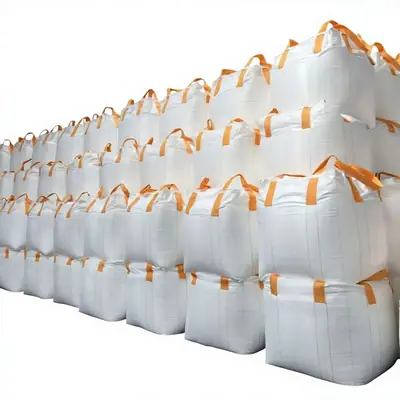
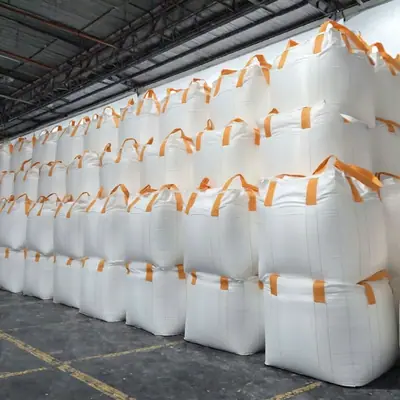
The FIBC industry is global. Woven polypropylene bulk bags are produced in many countries, but large-scale export production is concentrated in Asia, especially India and China, with other producers in Southeast Asia, Turkey, Mexico and elsewhere. A large share of the bulk bags used in North America is imported, either directly by end users or through domestic distributors and converters.
Typical fibc companies fall into four groups:
| Supplier type | What they do | Best for |
|---|---|---|
| US stocking distributor | Holds imported and domestic bags in US warehouses | Fast delivery, pallet quantities, standard sizes |
| US converter / manufacturer | Sews (and sometimes weaves) bags in the US, often from domestic or imported fabric | Short-run custom bags, quick turnaround, domestic-content needs |
| Asian factory-direct manufacturer | Extrudes, weaves, sews and ships full containers | High volume, custom specs and printing, lowest unit cost |
| Trading company / agent | Sources from one or more factories | Mixed product consolidation; check who actually makes the bag |
Option 1: FIBC manufacturers and suppliers in the USA
Strengths
- Speed. Stock bags commonly ship within days; short custom runs may take a few weeks.
- Low MOQ. Many suppliers sell by the pallet or even by the bag.
- Local support. Same time zone, same language, site visits and quick claims handling.
- Simpler buying. No customs filing, ocean freight or currency risk on your side.
- Domestic content. Important for some government or "Buy American" contracts — check what qualifies.
Trade-offs
- Higher unit price, because of US labor costs and, for imported stock, the distributor's freight, duty, warehousing and margin.
- Narrower custom options on stock programs; full custom designs often still come from overseas factories.
If you need 50 bags next week, a domestic supplier is almost always the right answer.
Option 2: FIBC manufacturers in India
India has a large, export-oriented FIBC industry with decades of experience. Production clusters are found in several states, including Gujarat, Rajasthan and Tamil Nadu — which is why searches such as jumbo bags manufacturers in Tamilnadu or big bags India are common among importers.
Strengths
- Deep experience supplying North American and European markets, including food grade and anti-static bags.
- Competitive pricing on full-container, custom orders.
- English widely used in business communication.
Trade-offs
- Ocean transit to the US East Coast is commonly in the range of about 4–6 weeks port to port, plus production time; routings via Suez or the Cape can change transit times.
- Minimum orders typically follow full-container economics.
- Time-zone gap with the Americas (though it suits overnight email turnaround).
Option 3: FIBC manufacturers in China
China has a large FIBC and woven-bag industry, with significant production in Shandong province (where Yantai and Qingdao are located) and other coastal provinces.
Strengths
- Integrated supply chains: resin, tape extrusion, weaving, webbing, liners and printing are often under one roof or nearby.
- Competitive pricing on custom, full-container orders and a wide range of designs.
- Frequent sailings from major ports such as Qingdao to the US East and Gulf coasts.
Trade-offs
- Transit from Qingdao to Savannah or Charleston is commonly about 5–7 weeks port to port depending on routing (Panama Canal or transpacific plus rail), plus production time.
- Tariff exposure: US duties on goods from China have changed several times in recent years. This is the largest single variable in landed cost — see the duties section below.
- Language and time-zone differences; clear written specifications matter.
We are a Chinese manufacturer in Yantai, shipping from Qingdao and Yantai, so we have an interest here — which is why we are explicit about the tariff question rather than skipping it.
Side-by-side comparison
| Factor | Domestic US supplier | Indian manufacturer | Chinese manufacturer |
|---|---|---|---|
| Typical lead time | Days (stock) to a few weeks (custom) | Several weeks production + ~4–6 weeks ocean | Several weeks production + ~5–7 weeks ocean |
| Typical MOQ | One pallet or less | Often one full container or a set bag count | Often one full container or a set bag count |
| Unit price | Highest | Lower | Lower |
| Custom design / printing | Limited on stock; available at a cost | Wide | Wide |
| Import work for buyer | None | Customs entry, ISF, freight, drayage | Customs entry, ISF, freight, drayage |
| Duty exposure | None at purchase (built into price) | Check current status | Check current status, often the key variable |
| Support | Local | Remote, English | Remote, English via sales team |
Lead times are typical ranges and vary with season, port congestion and order size.
What drives bulk bag prices?
Whichever region you buy from, the same cost drivers apply:
- Polypropylene resin price — the largest material cost, and it moves with oil and propylene markets.
- Fabric weight (g/m²) and SWL — a 1,500 kg bag uses more fabric and webbing than a 500 kg bag.
- Features — coating, liners, spouts, baffles, anti-static construction, dust-proof seams and UV stabilization each add cost.
- Printing — number of colors and sides.
- Order size — full containers spread setup and freight costs.
- Labor and overhead in the producing country.
- Freight, duties and fees — often decisive for imports.
- Exchange rates.
To compare quotes fairly, make every supplier quote the same written specification, then compare cost per tonne of product shipped, not just price per bag. Our bulk bag dimensions calculator and guide to choosing an FIBC help you write that specification.
Freight to Savannah and Charleston
For buyers in Georgia, South Carolina and the wider Southeast, the ports of Savannah and Charleston are the natural gateways for imported bulk bags. Georgia's kaolin, chemical, agricultural and forestry industries and the Carolinas' manufacturing base are large users of FIBCs.
What to plan for when importing a container:
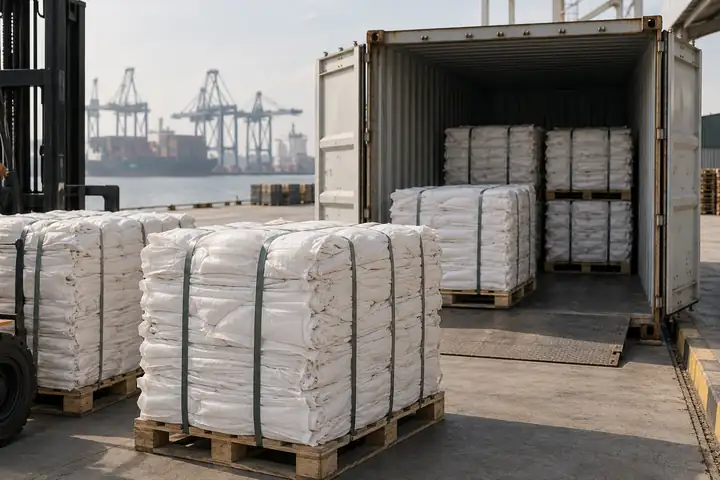
- Container capacity. Empty bags are baled flat, so a 40 ft high-cube container commonly holds several thousand standard 1-ton bags — the exact number depends on fabric weight, liners and features. Ask the factory for a loading plan.
- Incoterm. FOB Qingdao (or another origin port) means you control the ocean freight; CIF or DDP shifts that to the seller. See our importing checklist.
- Destination charges. Terminal handling, customs brokerage, ISF filing, drayage from the port to your warehouse, and possible demurrage or detention if the box is not returned on time.
- Inland delivery. Savannah and Charleston both connect to rail and interstate networks reaching Atlanta, Charlotte, Columbia and beyond.
If you are a smaller buyer in Georgia or South Carolina, a regional distributor that already imports through these ports may give you a better total cost than importing a full container yourself.
Duties: check current US tariff status
Woven PP bulk bags normally enter the US under HTS heading 6305 (flexible intermediate bulk containers are generally classified under subheading 6305.32). Total duty can include:
- The general (column 1) duty rate for the HTS code.
- Additional tariffs that apply to certain countries of origin, such as Section 301 tariffs on Chinese-origin goods and other country-specific measures introduced in recent years.
- Any anti-dumping or countervailing duty orders that may cover specific woven-sack products from specific countries — check whether your exact product falls within an order's scope.
- Standard customs fees such as the merchandise processing fee and harbor maintenance fee.
US tariff policy has changed frequently, so we deliberately do not quote rates here. Before you compare offers, ask a licensed US customs broker to confirm the current classification and total duty for each country of origin, and check the US International Trade Commission's Harmonized Tariff Schedule and US Customs and Border Protection guidance. Build the answer into your landed-cost comparison — it can change the ranking of quotes.
How to vet any bulk bag manufacturer
Location tells you about lead time and duty, not quality. For any supplier, ask for:
- An ISO 21898 top-lift test report for your exact design (SWL and safety factor). Our FIBC safety factor guide explains what to look for.
- A sample built to your specification, and your own trial fill.
- Fabric weight, coating, UV level and filler content stated in writing.
- Food-safety evidence if relevant — see food grade bulk bags.
- Pre-shipment inspection by you or a third party, with agreed acceptance criteria.
- Proof they make the bag themselves, or clarity about which factory does.
- Responsiveness: fast, clear answers before the order are a good predictor of support after it.
Where EGP fits
EGP (Yantai Evergreen Packaging) is a factory-direct FIBC and woven-bag manufacturer in Yantai, Shandong: 110 staff, a 3,500 m² facility and 24 years as an Alibaba.com supplier, with a 4.9/5 store rating, typical response within 8 hours and 90.9% on-time dispatch. We are a good fit for importers, distributors and processors ordering custom 1 ton bags and other FIBCs by the container — for example our Industrial Grade PP FIBC Jumbo Bags 500-2000kg Safety or Super Sack PP Woven Flat Bottom Jumbo FIBC Bag Cement. We are not the right choice if you need a few pallets next week; a domestic stocking supplier will serve you better.
To compare us fairly, send the same specification you send everyone else via our contact page, or browse the FIBC Bulk Bags range. For an overview of bag styles, see our super sacks guide.
Frequently asked questions
Are there FIBC manufacturers in the USA?
Yes. There are US companies that sew bulk bags domestically and some that also weave fabric, alongside many distributors that stock imported bags. Domestic production typically costs more per bag but offers short lead times and domestic-content compliance.
Where can I find bulk bag suppliers in Georgia or Savannah?
Georgia buyers can use regional stocking distributors, many of which import through the Port of Savannah, or import containers directly from manufacturers abroad. For full-container volumes, importing through Savannah is common; for smaller quantities, a local distributor is usually more economical.
Are there FIBC suppliers in South Carolina?
Yes, South Carolina buyers can source from regional distributors and converters or import directly through the Port of Charleston. Compare landed cost, lead time and test documentation rather than location alone.
Are FIBC manufacturers in India cheaper than China?
It depends on the specification, resin prices, exchange rates, freight and especially current US duties for each country of origin. Get quotes on the same specification and compare landed cost with figures confirmed by a customs broker.
What is the minimum order for 1 ton bags from an overseas factory?
Overseas factories usually price custom 1 ton bags on full-container or set-quantity orders, often in the hundreds to thousands of bags. Some will accept smaller trial orders or mixed containers at a higher unit price.
How long does it take to import bulk bags from Asia to the US East Coast?
Plan for several weeks of production plus roughly four to seven weeks of ocean transit to ports such as Savannah or Charleston, then customs clearance and inland delivery. Build in a buffer for sample approval on first orders.