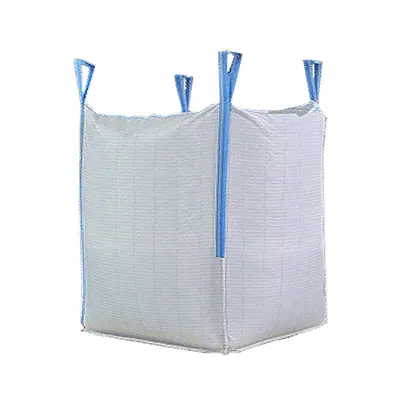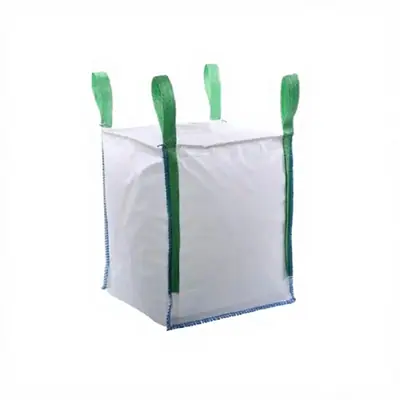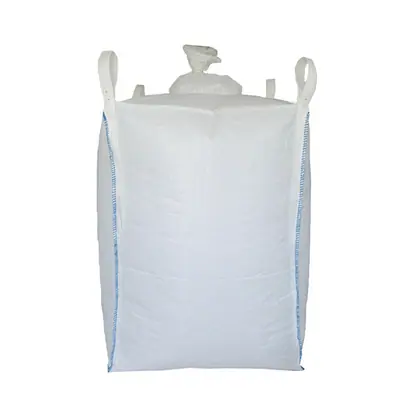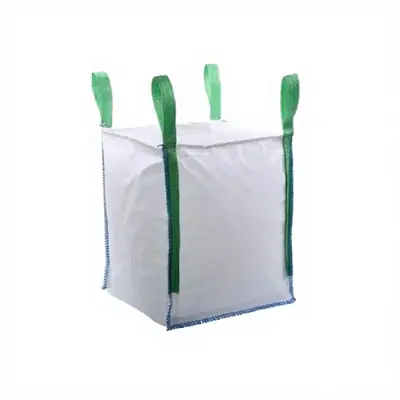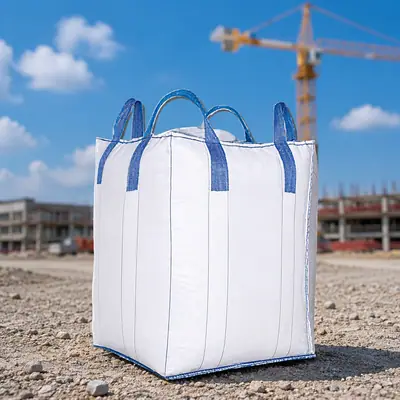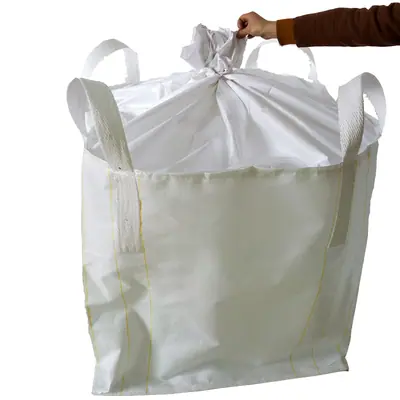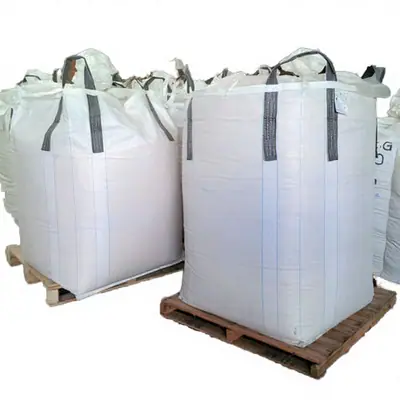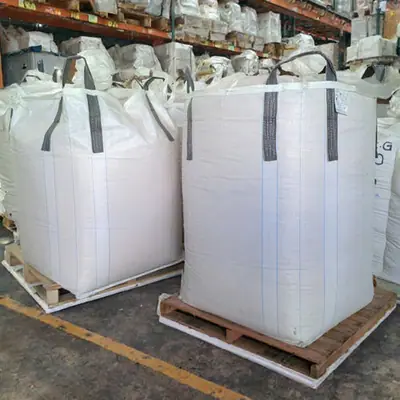
Key takeaways
- Most bulk bags use a 90 × 90 cm (35 × 35 in) or 95 × 95 cm (37 × 37 in) base; the height is what you size to your product.
- Volume = fill weight ÷ bulk density, then add about 10% headroom and divide by the base area to get the height.
- Check the reverse too: a full bag of a dense product can exceed its SWL before it looks full.
- Spouts are usually 35–50 cm (14–20 in) across; match them to your filling head and hopper.
Standard bulk bag dimensions are a 35 × 35 in (90 × 90 cm) or 37 × 37 in (95 × 95 cm) square base with a height between about 30 and 70 in (75–180 cm), which gives a volume of roughly 0.6 to 1.6 m³ (21–57 ft³). To find the right size of bulk bag for your product, divide the fill weight by the product's bulk density, add about 10% headroom, and divide by the base area to get the height. The rest of this article shows that FIBC bag calculation step by step, with worked examples in metric and imperial, and then turns it into a complete jumbo bag specification.
Skip the maths: our free bulk bag size calculator does this calculation for you in seconds.
If you are new to bulk bags, start with our guide to choosing an FIBC bulk bag, which explains body types, tops, bottoms and loops. This article goes deeper on the numbers.
What are the standard bulk bag sizes?
The base is set by the pallet and the truck or container; the height is set by the product.
| Base (in) | Base (cm) | Base area | Fits | Notes |
|---|---|---|---|---|
| 33 × 33 | 85 × 85 | 0.72 m² / 7.7 ft² | 1,000 × 1,000 mm and 1,200 × 800 mm pallets | Narrow aisles, small hoppers |
| 35 × 35 | 90 × 90 | 0.81 m² / 8.5 ft² | 48 × 40 in and 1,200 × 1,000 mm pallets | The most common size worldwide |
| 37 × 37 | 95 × 95 | 0.90 m² / 9.5 ft² | 1,200 × 1,000 mm pallets | More volume per bag, light products |
| 41 × 41 | 105 × 105 | 1.10 m² / 11.7 ft² | 1,200 × 1,200 mm pallets or no pallet | Very light products, crane handling |
A non-baffled bag bulges when full, so a 90 cm base grows to roughly 100–105 cm across the middle. That is why a 35 × 35 in bag is the usual choice for a 48 × 40 in pallet: it stays close to the pallet edge when filled. A baffle bag holds its square shape, so it can use a slightly larger base on the same footprint.
Common heights and volumes
| Size (cm) | Size (in) | Geometric volume | Approx. usable volume |
|---|---|---|---|
| 90 × 90 × 90 | 35 × 35 × 35 | 0.73 m³ / 25.7 ft³ | 0.66 m³ / 23 ft³ |
| 90 × 90 × 100 | 35 × 35 × 39 | 0.81 m³ / 28.6 ft³ | 0.74 m³ / 26 ft³ |
| 90 × 90 × 120 | 35 × 35 × 47 | 0.97 m³ / 34.3 ft³ | 0.88 m³ / 31 ft³ |
| 90 × 90 × 150 | 35 × 35 × 59 | 1.22 m³ / 42.9 ft³ | 1.10 m³ / 39 ft³ |
| 95 × 95 × 160 | 37 × 37 × 63 | 1.44 m³ / 51.0 ft³ | 1.31 m³ / 46 ft³ |
| 105 × 105 × 180 | 41 × 41 × 71 | 1.98 m³ / 70.0 ft³ | 1.80 m³ / 64 ft³ |
"Usable" here applies a 1.1 headroom factor (geometric ÷ 1.1). Real fill volume depends on how the product flows, whether it is vibrated or settled, and the top design, so treat these as planning figures and confirm with a trial fill.
How do you calculate bulk bag size? (bulk bag calculator)
You need two numbers: the fill weight (which becomes the safe working load, SWL) and the product's bulk density.
Step 1 — required volume
- Metric: V (m³) = fill weight (kg) ÷ bulk density (kg/m³)
- Imperial: V (ft³) = fill weight (lb) ÷ bulk density (lb/ft³)
Step 2 — add headroom
Multiply by 1.10 (1.05 for free-flowing, vibrated fills; up to 1.15 for fluffy, poorly settling products or where you need room to tie a duffle top).
Step 3 — height
- H = (V × 1.10) ÷ base area
Step 4 — sanity checks
- Height-to-width ratio: keep the filled bag's height to roughly 2 × the base or less. Taller bags lean and are hard to stack.
- Reverse check: calculate the weight of a completely full bag (usable volume × bulk density). If it exceeds the SWL, operators will overfill it. Shorten the bag or raise the SWL.
- Equipment: confirm total height plus loops fits under your filler and above your discharge hopper.
Useful conversions: 1 m³ = 35.31 ft³; 1 t/m³ = 62.4 lb/ft³; 1 in = 2.54 cm; 1,000 kg = 2,205 lb.
Typical bulk densities
| Product | t/m³ (kg/l) | lb/ft³ |
|---|---|---|
| Dry sand, gravel | 1.5–1.7 | 94–106 |
| Cement | 1.2–1.4 | 75–87 |
| Salt | 1.1–1.3 | 69–81 |
| Granular NPK fertilizer | 0.9–1.1 | 56–69 |
| Sugar | 0.8–0.9 | 50–56 |
| Wheat | 0.75–0.8 | 47–50 |
| Corn (maize) | 0.70–0.75 | 44–47 |
| Plastic pellets | 0.5–0.6 | 31–37 |
| Flour | 0.5–0.6 | 31–37 |
| Wood chips | 0.2–0.3 | 12–19 |
These are typical ranges. Measure your own product, because moisture, particle size and compaction change bulk density significantly.
Worked example 1 (metric): 1,000 kg of fertilizer
- Bulk density 1,050 kg/m³
- V = 1,000 ÷ 1,050 = 0.95 m³
- With headroom: 0.95 × 1.10 = 1.05 m³
- Base 90 × 90 cm = 0.81 m² → H = 1.05 ÷ 0.81 = 1.29 m
- Specification: 90 × 90 × 130 cm, 1,000 kg SWL
Worked example 2 (imperial): 2,000 lb of corn
- Bulk density 45 lb/ft³
- V = 2,000 ÷ 45 = 44.4 ft³
- With headroom: 44.4 × 1.10 = 48.9 ft³
- Base 37 × 37 in = 9.51 ft² → H = 48.9 ÷ 9.51 = 5.14 ft = 62 in
- Specification: 37 × 37 × 62 in (about 95 × 95 × 157 cm), 2,000 lb SWL
Worked example 3 (reverse check): sand in a "standard" bag
A 90 × 90 × 100 cm bag rated 1,000 kg is filled with dry sand at 1,600 kg/m³:
- Usable volume ≈ 0.81 ÷ 1.10 = 0.74 m³
- Full weight ≈ 0.74 × 1,600 = 1,180 kg — 18% over SWL
Fix it by choosing a shorter bag: 1,000 ÷ 1,600 × 1.10 ÷ 0.81 = 0.85 m, so 90 × 90 × 85 cm, or move to a 1,500 kg SWL bag. This mismatch is the most common cause of overloaded bags in aggregates; see bulk bags for sand and gravel.
Worked example 4: light product, height limit
500 kg of wood chips at 300 kg/m³ needs 500 ÷ 300 × 1.10 ÷ 0.90 = 2.03 m on a 95 × 95 cm base. That is too tall to handle comfortably. Options: a 105 × 105 cm base (1.66 m high), or reduce the fill to 400 kg (95 × 95 × 165 cm). Light, bulky products are often packed in large-volume bags such as our Flexible Woven FIBC Bulk Bag Strong Lift Straps for Wood.
Bulk bag spout dimensions: top and bottom
A super sack with spout is specified by the spout's diameter and length, and the dimensions must match your equipment.
| Feature | Typical diameter | Typical length | Notes |
|---|---|---|---|
| Filling spout (top) | 35–50 cm / 14–20 in | 45–60 cm / 18–24 in | Must seal around the filler's fill head |
| Duffle (skirt) top | Full bag width | Usually 50 cm / 20 in or more | Gathered and tied; suits wide fill heads, grabs, conveyors |
| Discharge spout (bottom) | 35–45 cm / 14–18 in | 45–60 cm / 18–24 in | Must reach into the hopper or iris valve |
| Full-open discharge | Full bag width | — | "Dump bottom" for fast emptying of coarse products |
The standard US spout is often described as 14 × 18 in (diameter × length). Discharge spouts are usually protected by a petal (star) closure — four or more fabric flaps tied over the spout — which keeps the spout tied inside, protects it from forks and adds a second barrier against sifting.
Duffle top spout bottom: when to use it
The duffle top spout bottom combination is one of the most popular configurations. The duffle top lets you fill from a wide chute, a conveyor or a loader bucket without lining up a spout, then tie the skirt closed. The discharge spout gives controlled emptying into a hopper, mixer or screw conveyor. It suits feed, fertilizer, salt, chemicals in granular form and food ingredients filled manually.
Choose a spout top instead when you fill on an automatic line with dust control; see our bulk bag filling and discharging equipment guide. Our Large Capacity Jumbo Bag Integrated Discharge Outlet shows a typical discharge spout design.
What goes in a jumbo bag specification?
A complete FIBC bulk bag specification sheet removes guesswork for both the buyer and the factory. Use this checklist:
| Field | Example values |
|---|---|
| Product and bulk density | Granular NPK, 1.05 t/m³ |
| SWL and safety factor | 1,000 kg, 5:1 (single trip) |
| Body construction | U-panel / four-panel / tubular / baffle |
| Dimensions (L × W × H) | 90 × 90 × 130 cm |
| Body fabric | 170 g/m², coated, UV-stabilized, white |
| Bottom fabric | Same as body or heavier |
| Top | Duffle 90 × 90 × 50 cm, tie |
| Bottom | Discharge spout 40 × 50 cm with petal closure |
| Loops | 4 cross-corner loops, 25–30 cm loop height, 70 mm webbing |
| Liner | None / tubular / form-fit, thickness in µm or mil |
| Seams | Standard, or sift-proof with filler cord |
| Electrostatic type | Type A / B / C / D (see types of FIBC bags) |
| Printing | 1–2 sides, colors, artwork |
| Extras | Document pouch, labels, baffles |
| Packing | Bales per pallet, bags per bale |
Fabric weights, loop sizes and webbing widths above are typical starting points; the factory adjusts them to the SWL and safety factor. For load-rated details, see our 5:1 vs 6:1 safety factor guide.
How bulk bag dimensions affect shipping
Bulk bag size also decides how many bags fit on a truck or in a container. Dense products such as sand or cement are weight-limited: a 20 ft container commonly carries around 20 bags of 1 tonne. Light products are volume-limited, so a taller bag or a baffle bag can add significant payload. A 90 × 90 cm base that bulges to about 1 m across lets you place two bags across the width of a container and stack two high if the filled height stays under about 1.15 m. Our article on baffle bulk bags shows how square bags improve these numbers.
Getting a custom size from EGP
EGP manufactures bulk bags to your dimensions in Yantai, China — for example our 90 90 150cm 1000Kg Printed FIBC Bulk Bag Ton Bag PP Jumbo or the cross-corner Durable PP Woven FIBC Jumbo Bulk Bags 500-2000kg built in 500–2,000 kg ratings. Send your product, bulk density, fill weight, pallet size and filling method via our contact page, and we will return a dimensioned drawing and quotation. Browse all FIBC Bulk Bags.
Frequently asked questions
What size is a 1 ton bulk bag?
For a medium-density product (about 1 t/m³), a 1 ton bulk bag is typically 90 × 90 × 120–130 cm (35 × 35 × 47–51 in). Dense products such as sand need a shorter bag of around 90 × 90 × 85 cm, while grain needs about 90 × 90 × 150 cm or more.
How do I calculate how much a bulk bag holds?
Multiply length × width × height to get the geometric volume, divide by about 1.1 for usable volume, then multiply by your product's bulk density. For example, 0.97 m³ ÷ 1.1 × 1,000 kg/m³ ≈ 880 kg.
What is the standard bulk bag spout size?
Filling and discharge spouts are commonly 35–45 cm (14–18 in) in diameter and 45–60 cm (18–24 in) long; 14 × 18 in is a frequent US default. Always match the spout to your filling head and hopper inlet.
How tall can a bulk bag be?
Bags up to about 2 m (79 in) are made, but most stay below 1.6–1.8 m. Keep the filled height to roughly twice the base width or less for stability, and check the clearance under your filler and over your discharge station.
Does a filled bulk bag keep its dimensions?
No. A standard bag bulges at the sides when filled, adding roughly 10–15% to its width at the middle. If you need a square, stable shape for container loading or racking, specify a baffle bag.