Key takeaways
- FIBCs are made in seven main stages: resin compounding, tape extrusion, weaving, coating, printing, cutting and sewing, followed by inspection and testing.
- Polypropylene film is slit into tapes and stretched several times its length — that orientation is where the fabric gets its strength.
- Circular looms weave seamless tubes for tubular bags; flat fabric is used for U-panel and four-panel bags.
- Every design should be proven by an ISO 21898 top-lift test to its rated safety factor (5:1 or 6:1).
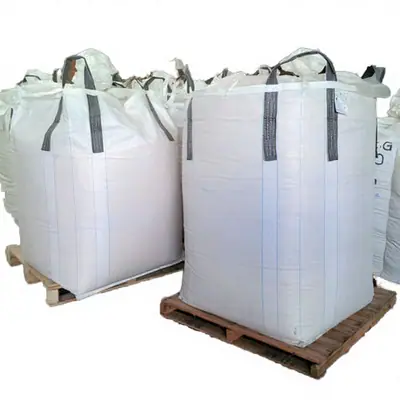
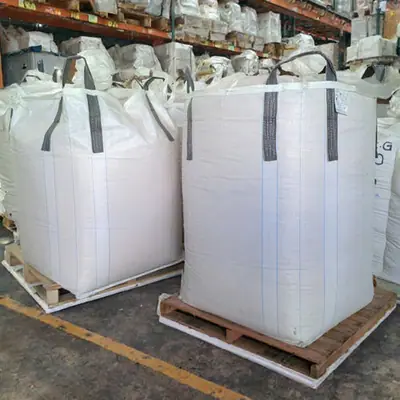
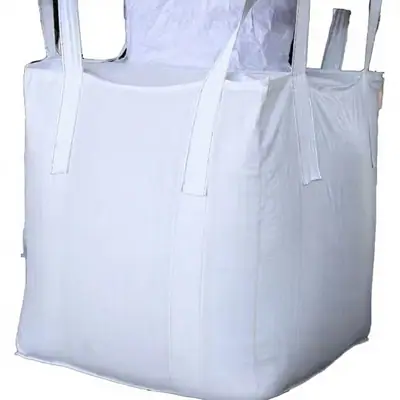
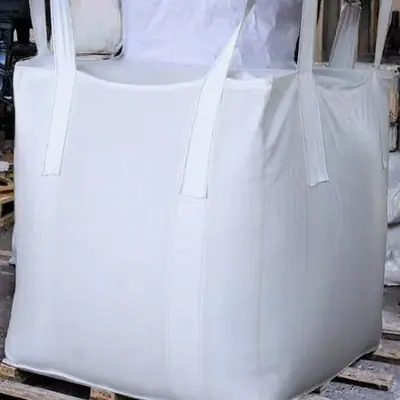
FIBC bulk bags are made by melting polypropylene resin into a thin film, slitting and stretching it into strong flat tapes, weaving those tapes into fabric on circular or flat looms, optionally coating and printing the fabric, then cutting it into panels and sewing it together with lifting loops, spouts and liners. Finished bags are cleaned, inspected and baled, and each design is proven by a destructive top-lift test to its safety factor.
Knowing the FIBC manufacturing process helps you write a better specification and ask sharper questions of any supplier. If you want to know what to order rather than how it is made, read how to choose an FIBC bulk bag first.
Overview of jumbo bag manufacturing
| Stage | What happens | Typical parameters (industry ranges) |
|---|---|---|
| 1. Compounding | PP homopolymer mixed with UV stabilizer, color masterbatch and limited filler | UV level commonly specified as 200–1,600 hours of accelerated weathering |
| 2. Tape extrusion | Film extruded, slit into tapes, stretched and annealed | Stretch ratio roughly 5–7:1; tapes commonly 1,000–2,000 denier |
| 3. Weaving | Tapes woven on circular or flat looms | Body fabric commonly 140–240 g/m² for 500–2,000 kg bags |
| 4. Coating | PP/PE melt laminated onto fabric (optional) | Commonly 20–35 g/m² coating |
| 5. Printing | Flexographic print of logo, SWL and handling marks | 1–4 colors, 1–4 sides |
| 6. Cutting | Fabric, webbing and spouts cut to size, edges heat-sealed | Hot-knife or hot-blade cutting |
| 7. Sewing | Panels, loops, top and bottom assembled | Lock-stitch or chain-stitch seams, PP or polyester thread |
| 8. Finishing and QC | Liners fitted, bags cleaned, inspected, baled | Light table, metal detection for food grade |
| 9. Testing | Design qualification to ISO 21898 | Top-lift to 5× or 6× SWL |
These are typical industry figures. The exact values for any bag depend on its safe working load, product and specification.
Step 1: Polypropylene resin and additives
Polypropylene jumbo bags start as PP homopolymer pellets. Polypropylene is used because it is strong for its weight, chemically inert to most dry products, moisture-resistant and recyclable (resin code #5).
The resin is blended with:
- UV stabilizer — essential, because unprotected PP loses strength quickly in sunlight. The dose determines how long a bag can sit outdoors.
- Color masterbatch — white is most common; beige, black and other colors for branding or light protection.
- Calcium carbonate (CaCO₃) filler — small amounts help tape processing, but heavy filler loading cuts cost at the expense of strength. Ask suppliers about filler content; it is a common hidden quality difference.
For food grade production, only virgin food-contact compliant resin and additives are used; see food grade bulk bags.
Step 2: Tape extrusion — where the strength comes from
Tape extrusion is the heart of pp woven jumbo bags:
- The blend is melted in an extruder at roughly 230–260 °C (450–500 °F) and pushed through a flat die into a thin film.
- The film is quenched in a water bath or on chill rolls.
- Blades slit the film into narrow tapes, typically a few millimeters wide.
- The tapes run through heated ovens and over godet rollers turning at increasing speeds, which stretches them several times their original length. Stretching aligns the polymer chains and multiplies tensile strength.
- An annealing stage relaxes internal stresses so the tapes do not shrink later.
- Tapes are wound onto bobbins for the looms.
Quality checks here include tape denier (weight in grams per 9,000 m), tenacity (strength per denier) and elongation at break. Consistent denier means consistent fabric weight; good tenacity means you get the strength you pay for without excess fabric.
Step 3: Weaving on circular looms and flat looms
Circular looms
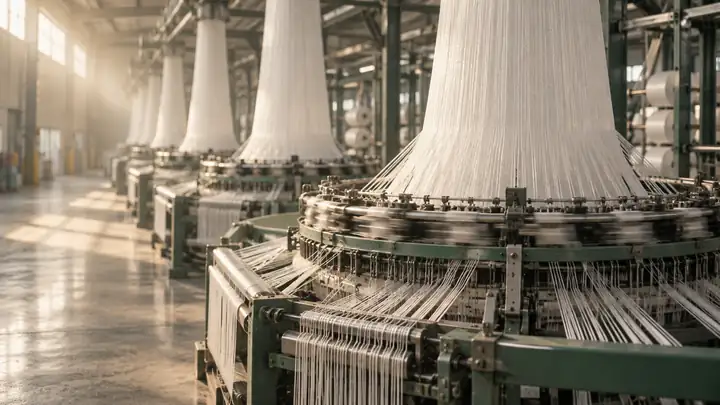
Circular looms carry several shuttles (commonly four to eight) that orbit continuously, interlacing weft tape through a ring of warp tapes. The output is a seamless tube of fabric, wound onto a roll at the base of the loom.
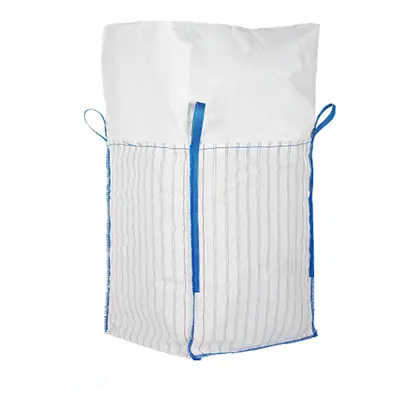
Tubular fabric is used for tubular (circular) FIBCs — the bag body has no vertical side seams, which means fewer weak points and fewer sifting paths for fine powders. Our FIBC Virgin PP Breathable Tubular Jumbo Bulk Baffle is built on a tubular body.
Flat looms
Flat (sheet) fabric is used for U-panel and four-panel bags, for top and bottom panels, and for baffles. Flat fabric can also be made by slitting tubular fabric.
Fabric specification
Fabric is specified by weight (g/m²), mesh (tapes per inch or per 10 cm in warp and weft) and strip tensile strength (often in N/5 cm). Higher SWL bags need heavier fabric or stronger tapes. As a broad guide, a 1,000 kg, 5:1 bag commonly uses body fabric somewhere around 160–200 g/m², but the right figure is whatever passes the top-lift test for that design.
Step 4: Coating (lamination)
Fabric can be uncoated (breathable) or coated:
- Uncoated fabric lets moisture and air escape — the right choice for firewood, potatoes, some aggregates and products that must breathe.
- Coated fabric has a thin layer of molten PP or PE extruded onto one side. It closes the weave so fine powders cannot sift through and slows moisture ingress.
Coating also slightly stiffens the fabric and improves print quality. It is not a substitute for a liner when a true moisture barrier or hygiene barrier is needed; see bulk bag liners.
Step 5: Printing
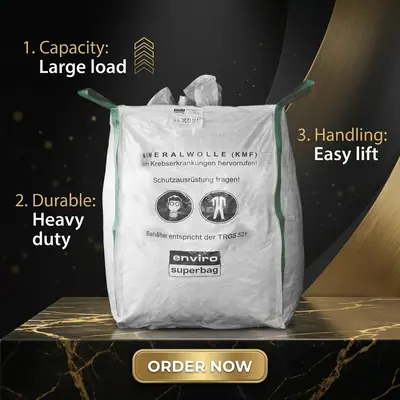
Fabric is printed on flexographic presses, usually before cutting. Typical bag printing includes the customer logo, product name, safe working load and safety factor, handling pictograms ("do not stand under suspended load") and lot or date codes. Our 90 90 150cm 1000Kg Printed FIBC Bulk Bag Ton Bag PP Jumbo is an example of a printed jumbo bag. Many buyers also add a document pouch for the delivery note.
Step 6: Cutting
Body fabric, top and bottom panels, spouts, baffles and lifting webbing are cut to length on automatic cutting machines. A hot knife or heated blade melts and seals each cut edge so the tapes do not fray. Accurate cutting matters: a few centimeters' error on a panel becomes a skewed bag that leans when filled.
The lifting loops are cut from woven PP webbing, commonly 50–70 mm (2–2.75 in) wide and specified by breaking strength.
Step 7: Sewing and assembly
Sewing is the most labor-intensive stage and the one that most affects safety. Operators on heavy-duty industrial sewing machines:
- Join body panels (or close the tube) and attach the top and bottom panels.
- Sew in filling and discharge spouts with closure tie cords or petal flaps.
- Attach the lifting loops — cross-corner, side-seam or tunnel loops — with reinforced stitch patterns.
- Insert baffles for Q-bags, see baffle bags.
- Add dust-proof seams for fine powders, using a filler cord or tape sewn into the seam to block sifting.
- Fit or tab in liners, and attach labels and document pouches.
Seam strength and stitch density are critical: in most bag failures, the loop-to-body joint or a seam gives way before the fabric does. The Reinforced Seam Jumbo Big Bag High Breaking Strength shows the kind of reinforced construction used for heavy, abrasive products.
Step 8: Finishing and inspection
Before packing, each bag is typically:
- Trimmed of loose threads.
- Cleaned with compressed air or vacuum, especially for food and pharma grades.
- Inspected on a light table, which shows holes, thin spots and contamination.
- Metal-detected, where the specification requires it.
- Folded and baled — commonly in bales of 10–50 bags — compressed and wrapped for export.
Step 9: Testing — the top-lift test and ISO 21898
Every bag design should be qualified by testing to ISO 21898 (the international standard for non-dangerous goods FIBCs) or an equivalent. The key test is the top-lift test:
- The bag is filled with a test material and lifted by its loops in a test rig.
- It is first cycled repeatedly to a load above its SWL to simulate handling.
- It is then loaded to its full safety-factor multiple — 5 × SWL for single-trip bags, 6 × SWL for multi-trip bags — and must not drop its contents.
Other tests in the standard family include drop, topple, righting, stacking and tear-propagation tests. Bags for hazardous goods face additional UN tests. Our FIBC safety factor guide explains what these ratings mean in daily use.
Routine production quality control usually checks fabric weight, tensile strength, webbing strength and dimensions on every lot, with periodic top-lift tests to confirm the design still performs. When you buy, ask for the test report for your exact design — not a generic certificate for a different bag.
What the manufacturing process means for buyers
- Specify fabric weight and coating explicitly. "Jumbo bag 1 ton" leaves room for lighter fabric.
- Ask about filler content and UV dose, especially for outdoor storage.
- Choose tubular bodies for fine powders and dust-proof seams if sifting is a concern.
- Request a sample and a test report before the first container — our importing checklist covers the full process.
- Plan lead time: compounding to baling takes several weeks for a custom order, depending on loom capacity and order size.
EGP (Yantai Evergreen Packaging) runs its woven bag and FIBC production from a 3,500 m² facility in Yantai, Shandong, with 110 staff. If you want to discuss a specification, see our FIBC Bulk Bags range or contact us for a drawing and sample.
Frequently asked questions
What material are FIBC bags made of?
FIBC bags are made of woven polypropylene tapes, usually with UV stabilizer and color additives. Loops are PP webbing, threads are PP or polyester, and optional liners are polyethylene film.
What machines are used in FIBC manufacturing?
The main machines are a tape extrusion line, circular and flat looms, a coating (lamination) line, flexographic printing presses, automatic cutting machines and heavy-duty industrial sewing machines. Food grade lines add bag-cleaning systems, light tables and metal detectors.
Why are polypropylene tapes stretched?
Stretching aligns the polymer chains along the length of the tape, which raises its tensile strength several times over. This is why a light woven fabric can safely carry a tonne or more.
What is the difference between circular and flat loom fabric?
Circular looms weave a seamless tube used for tubular FIBCs, which have no vertical body seams and resist sifting. Flat looms produce sheet fabric used for U-panel and four-panel bags and for panels such as tops, bottoms and baffles.
How is a jumbo bag tested?
Each design is qualified with a top-lift test under ISO 21898: the bag is cycled under load and then pulled to five or six times its safe working load without losing contents. Drop, topple, stacking and tear tests are also part of the standard.
How long does it take to manufacture a custom bulk bag order?
It depends on the specification and quantity, but a custom order typically takes several weeks from approved drawing to baled bags, plus sea freight time. Simple repeat orders are usually faster than first orders with new printing or features.