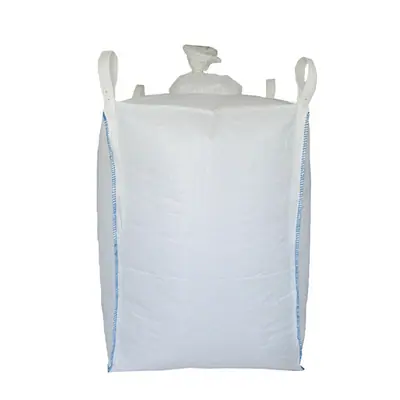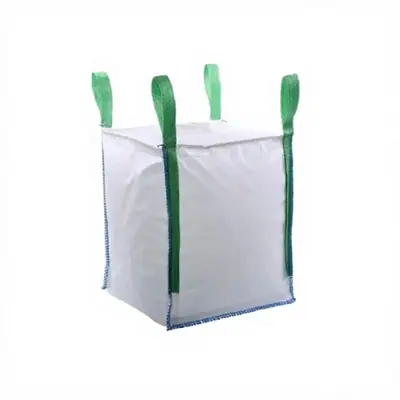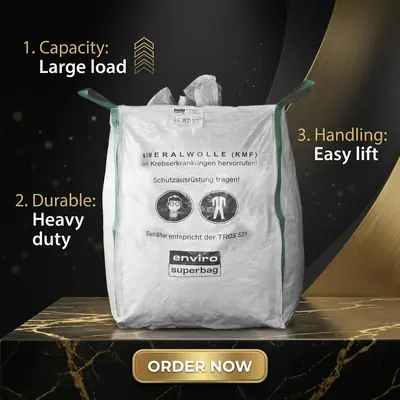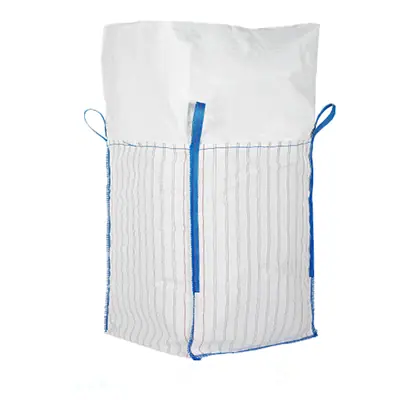
Key takeaways
- A bulk bag price is set mainly by how much fabric the bag uses (size × GSM), its safe working load and safety factor, and its options: coating, liner, spouts, baffles and printing.
- Order size, MOQ, container loading and Incoterms often move the landed cost per bag as much as the bag itself.
- "Cheap bulk bags" usually mean lighter fabric, recycled resin or no test data: compare quotes spec for spec, not price for price.
- For an accurate quote, send product, bulk density, fill weight, dimensions, top/bottom, loops, liner, printing, quantity and destination port.
A bulk bag price depends on the specification more than on the name "FIBC" or "super sack": the amount and weight of polypropylene fabric (bag size × fabric GSM), the safe working load and safety factor, and options such as coating, liners, spouts, baffles and printing set the factory cost. Order quantity, minimum order quantity, freight, container loading and Incoterms then decide the landed cost per bag. To get an accurate quote, send the supplier a complete specification, not just "1-ton bag."
Definition: The price of an FIBC bulk bag is the cost of its materials and conversion (fabric, loops, thread, liner, fittings, printing and labor) plus testing, packing and the share of freight and duties carried by each bag under the agreed Incoterm.
This guide explains the twelve cost drivers we see on every bulk bag order, how to compare fibc bags prices fairly and exactly what to send for a quote. We do not publish price lists, because resin costs, freight rates and specifications change too much for a single number to be useful.
How much do bulk bags cost? Why FIBC bulk bags price lists mislead
Two bags that both say "1,000 kg" can differ widely in cost. One may be a light uncoated open-top bag for a single trip of firewood; the other a coated, lined, four-panel bag with spouts, baffles and four-color print for food powder. Asking "how much do bulk bags cost" without a specification is like asking what a truck costs.
What you can control is the specification. The table below shows how each choice moves the price relative to a plain bag.
What are the main cost drivers for FIBC bulk bags?
| # | Cost driver | Typical options | Effect on price |
|---|---|---|---|
| 1 | Fabric weight (GSM) | about 120–220+ g/m² body fabric | Major: resin is the largest single cost |
| 2 | Bag size | e.g. 90 × 90 × 90 cm to 100 × 100 × 200 cm | Major: more fabric area |
| 3 | Safe working load and safety factor | 500–2,000 kg; 5:1 or 6:1 | Higher SWL and 6:1 need heavier fabric and loops |
| 4 | Construction | tubular, U-panel, four-panel, baffle | Baffles and four-panel add sewing time |
| 5 | Coating / lamination | uncoated or coated | Coating adds material and a process step |
| 6 | Liner | none, loose, tabbed, form-fit; PE about 50–150 µm | Form-fit and barrier liners cost most |
| 7 | Top and bottom | open, duffle, spouts, discharge closures | Each spout adds fabric and labor |
| 8 | Loops and extras | cross-corner, side-seam, 1- or 2-loop; document pouch, ties | Minor to moderate |
| 9 | Anti-static and UV | Type A, B, C, D; UV stabilizer | Type C/D fabric costs more; UV adds additive |
| 10 | Printing and labels | none, 1–4 colors, one or more sides | Plates per color plus ink and press time |
| 11 | Quantity and MOQ | sample lot to many containers | Larger orders spread setup costs |
| 12 | Freight, packing and Incoterms | EXW, FOB, CFR, CIF, DDP; baled vs palletized | Can rival the bag cost on small orders |
Ranges are typical industry values; your own product and handling decide what you actually need.
Fabric is most of the cost: a worked example
A 90 × 90 × 120 cm (35 × 35 × 47 in) bag has roughly 4 × 0.9 × 1.2 = 4.32 m² of side fabric plus 2 × 0.81 = 1.62 m² for top and bottom, about 5.94 m² (64 ft²) before loops and spouts. At 160 g/m² the body fabric weighs about 0.95 kg; at 200 g/m² it weighs about 1.19 kg, which is 25% more resin for the same size bag. That is why two quotes for "the same bag" can differ: check the GSM line first.
Safety factor, testing and certifications
Bags for one-way use are typically rated 5:1 and reusable bags 6:1, as tested under ISO 21898 (see our safety factor guide). Heavier loads need stronger fabric, loops and sewing, and anyone selling FIBCs for lifting should be able to show test reports for that design. Anti-static types tested to IEC 61340-4-4, UN-marked bags for dangerous goods and food-grade production add testing and process cost, but these are requirements, not optional extras, when your product needs them.
Options that quietly add cost
- Spouts: a filling spout and a discharge spout each add fabric, sewing and a closure.
- Baffles: internal panels keep the bag square, which saves space in containers and warehouses but adds fabric and labor.
- Liners: protect fine or hygroscopic products; a form-fit liner costs more than a loose one.
- Printing: each color needs a plate; printing on more sides adds press time. Plain bags with a sewn label are cheapest.
Why are some bulk bags so cheap?
When you see "cheap bulk bags" listed as bulk bags for sale or fibc bags for sale far below other quotes, ask what was removed:
- Lower GSM fabric that meets the weight rating on paper only;
- Recycled or filled resin in the fabric or loops, which makes strength less predictable;
- Fewer stitches per inch or a weaker thread;
- No current test report for the design;
- Used bags, whose history, UV exposure and previous contents are unknown.
For aggregates in a one-time landscape job, a modest, honest single-trip bag is fine. For lifting over people, food contact or chemicals, the cheapest bag is rarely the lowest-cost bag once a failure is counted.
Small bulk bags vs full-size: which costs less per tonne?
Small bulk bags (250–500 kg, often about 0.2–0.5 m³ or 7–18 ft³) cost less each, but more per tonne carried, because loops, seams and handling are spread over less product. They make sense when the customer's equipment, floor loading or manual handling requires them. For pure cost per tonne, a well-specified 1,000–1,500 kg bag is usually the most economical.
Bulk bags wholesale: MOQ, order size and freight
Minimum order quantity bulk bags
Factory direct bulk bags are made in production runs. Every new specification requires machine setups, and printed bags need plates, so manufacturers set a minimum order quantity per design. MOQs vary by factory, by how standard the bag is and by whether it is printed. Ask for the MOQ at the same time as the quote, and ask whether combining sizes in one container is possible.
Container loading and freight
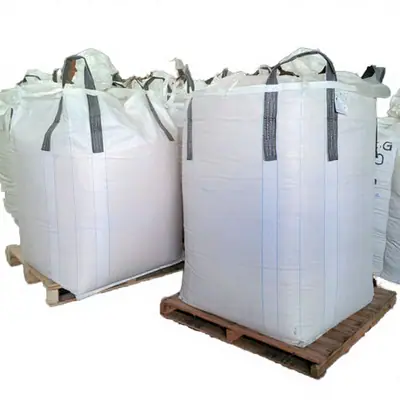
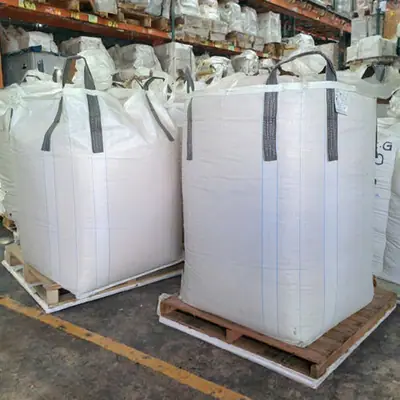
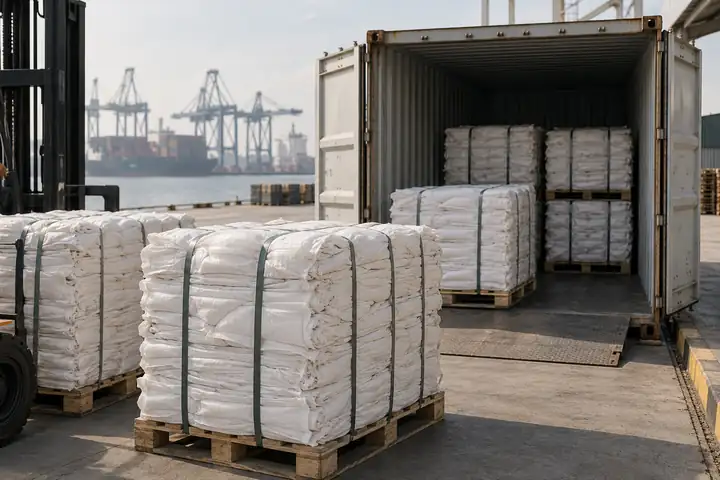
Bulk bags are usually baled (folded and compressed) and either palletized or floor-loaded. How many bags fit in a 20 ft or 40 ft container depends on the bag's weight and folded volume, so a lighter bag also costs less to ship per unit. On small orders, freight, origin charges, customs clearance and inland delivery can add as much as the bags themselves; a full container load spreads those costs widely. Our importing checklist covers duties and paperwork, and the bulk bag suppliers guide compares domestic and overseas sourcing.
Incoterms: compare like with like
A price "FOB Qingdao" excludes ocean freight and insurance; "CIF" includes them to your port; "DDP" includes duties and delivery to your door. Comparing an EXW quote with a DDP quote is meaningless. Ask every supplier to quote on the same Incoterm and destination.
How do I get an accurate bulk bag quote?
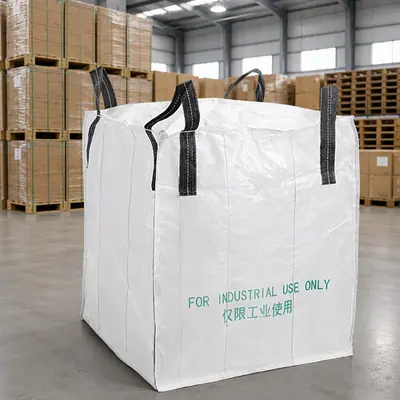
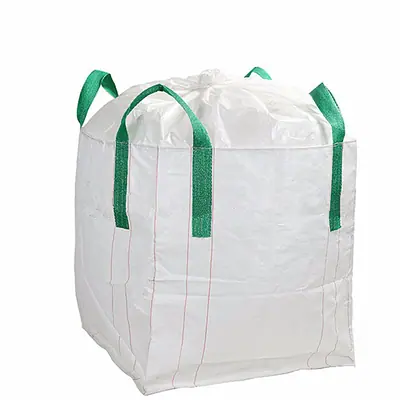
A good bulk bag order starts with a complete specification. Our how to choose an FIBC guide walks through each choice, and the bulk bag size calculator helps with dimensions. Typical examples from our range include the Industrial Grade PP FIBC Jumbo Bags 500-2000kg Safety for single-trip industrial use, the Durable Breathable PP Woven Flat Bottom Jumbo Bags 1000kg for coarse, breathable loads, the Large Capacity Jumbo Bag Integrated Discharge Outlet for spout discharge and the printed 90 90 150cm 1000Kg Printed FIBC Bulk Bag Ton Bag PP Jumbo. Browse all FIBC Bulk Bags.
What to send us for a quote
- Product and its bulk density (t/m³ or lb/ft³), particle size and moisture sensitivity
- Fill weight / SWL and safety factor (5:1 single trip or 6:1 reusable)
- Dimensions (base and height, cm or in) or the volume you need
- Construction: tubular, U-panel, four-panel or baffle
- Top: open, duffle or filling spout (diameter and length)
- Bottom: flat or discharge spout (diameter, closure type)
- Loops: type, number and height
- Coating, liner (type and thickness), UV and anti-static type, if needed
- Printing: colors, sides and artwork
- Quantity per order and per year
- Destination port and preferred Incoterm
- Any required documentation (test reports, food-contact or UN requirements)
Yantai Evergreen Packaging manufactures FIBC bulk bags in Yantai, Shandong, and has 24 years as an Alibaba.com supplier with a 4.9/5 store rating. Send the checklist above through our contact page; we typically reply within 8 hours with questions or a quotation.
Frequently asked questions
How much does a super sack cost?
Super sack cost depends on size, fabric weight, safe working load, coating, liner, spouts, printing, order quantity and freight terms, so there is no fixed price. Two "1-ton" bags can differ widely in cost. Send a full specification to get a firm quote.
Why do FIBC bags prices vary so much between suppliers?
Quotes often differ in fabric GSM, resin quality, safety factor, testing and Incoterms rather than in efficiency. Compare quotes line by line on the same specification and the same delivery terms, and ask for test reports for the design.
What is the minimum order quantity for bulk bags?
Manufacturers set MOQs per design because each specification needs machine setup and printed bags need plates. The figure depends on the factory and on how custom the bag is, so ask for it with your quote and check whether several sizes can share one container.
Are cheap bulk bags safe to use?
Some are fine for light, one-way, non-hazardous loads, but very low prices often mean lighter fabric, recycled resin or no test data. For lifting, food or chemicals, use bags with a documented safety factor tested under ISO 21898.
Is it cheaper to buy factory direct bulk bags?
Factory-direct purchasing usually lowers the unit cost on full-container orders, especially custom or printed bags, but you take on lead time, MOQs, freight and import paperwork. For small or urgent needs, a local distributor's stock may cost less overall.