Key takeaways
- A valve bag filling machine pushes powder through a spout inserted in the bag's corner sleeve and stops on a weight signal; the valve then self-closes or is sealed.
- Impeller packers suit free-flowing, abrasive powders like cement; air packers suit fine, fluidizable powders and dry-mix; auger packers suit sticky, fluffy or poorly flowing powders such as flour.
- The bag must match the machine: valve width, sleeve type, venting and dimensional consistency decide filling speed and cleanliness.
- Always run trial bags on your own packer before a full order.
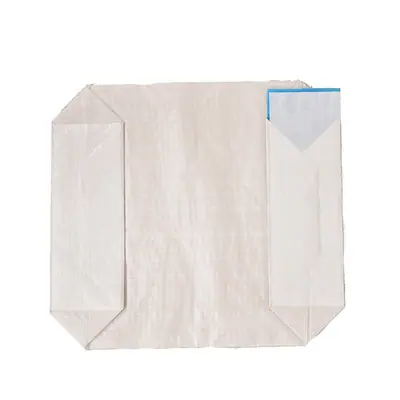
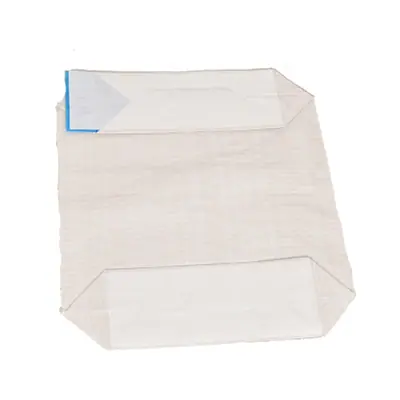
A valve bag filling machine (valve packer) fills a pre-closed sack through a small sleeve in one top corner: the operator or an automatic applicator slides the bag's valve over the filling spout, the machine drives product into the bag until a load cell reaches target weight, and the bag drops off with the valve closed by product pressure, a tuck-in flap, heat or ultrasonic sealing. The three main types are impeller (centrifugal) packers, air packers and auger packers, chosen by how the powder flows.
This article explains how each valve bagging equipment type works, which products it suits, and — the part often overlooked — how to specify bags that run well on it. For the difference between valve and open-mouth formats in general, see our valve bags vs open-mouth bags guide.
How does a valve bag filler work?
Every valve filler has the same core parts:
- Feed hopper above the machine, often with level control and aeration.
- Feeding mechanism — impeller, air chamber or auger — that pushes powder into the spout.
- Filling spout (nozzle) that fits inside the bag valve, sometimes with an inflatable sleeve that seals against the valve to reduce dust.
- Weighing system — usually gross weighing on a saddle or chair under the bag, with a coarse-then-fine feed to hit target weight.
- Discharge — the bag is tipped or pushed onto a conveyor; the valve closes as product presses against the inner sleeve, or a sealer closes it.
Air entrained with the powder must leave the bag while it fills. It escapes through the porous paper, micro-perforations in woven fabric or film, or back along the spout. Venting is therefore a joint property of the bag and the machine, and it is the most common cause of slow filling and dusty bags.
Impeller vs air vs auger packers
| Packer type | How it moves powder | Best for | Typical strengths | Watch-outs |
|---|---|---|---|---|
| Impeller (centrifugal) | A rotating impeller flings powder into the spout | Cement, fly ash, lime, gypsum, free-flowing minerals | High speed; robust; the standard for cement, often in rotary multi-spout form | Wear on abrasive products; adds air; less suited to fragile or sticky products |
| Air packer | Low-pressure air fluidizes powder in a chamber, which flows out under pressure | Dry-mix mortar, tile adhesive, fine chemicals, pigments, some food powders | Gentle; few moving parts; good for blends that must not separate; easier cleaning | Needs a powder that fluidizes well; compressed-air use; bags must vent well |
| Auger (screw) | A rotating screw meters powder into the spout | Flour, starch, cocoa, fluffy or cohesive powders, products that will not fluidize | Accurate on difficult powders; little added air | Slower; screw wear; less suited to very abrasive materials |
| Vacuum / de-aerating packers | Air is drawn out of the bag or product during filling | Very light, airy powders such as fumed silica | Densifies product; smaller bags | Specialized and slower |
| Gravity / belt valve fillers | Product falls or is belted into the valve | Free-flowing granules, pellets | Simple and gentle | Not for fine powders |
Single-spout vs rotary packers
Small plants and dry-mix producers often use single- to four-spout inline packers with manual bag placing. Cement plants typically run rotary packers with many spouts on a turning carousel, fed by an automatic bag applicator; these are commonly rated in the range of a couple of thousand bags per hour or more. At that speed, bags must open, seat and vent consistently — a few millimeters of variation in valve width can cause misplacements and stoppages.
What is a flour bag filler?
A flour bag filler is usually an auger valve packer (or an auger-fed open-mouth bagger) because flour is cohesive, light and does not fluidize as predictably as cement. Food plants also need sanitary design: stainless contact parts, easy-clean hoppers and dust extraction.
Typical flour packs are 25 kg, 50 lb and 50 kg in multiwall paper valve bags, or woven PP with a fine, coated fabric to prevent sifting. Our Bottom Gusset Bag with Valve Pocket PP Woven Fabric 25KG is a woven valve option; paper options are covered in our multiwall paper bags guide and food requirements in our food packaging bags guide.
Valve sleeve types
The valve is the bag's interface with the machine. The main types:
| Valve type | How it closes | Dust tightness | Equipment needed | Typical use |
|---|---|---|---|---|
| Internal (inner) valve | Product pressure pushes the inner sleeve shut | Fair–good | None extra | Cement, minerals; lowest cost |
| External / extended sleeve (tuck-in) | Sleeve is folded in by hand or mechanically | Good | Optional tucker | Dry-mix, chemicals |
| Heat-seal valve | PE-coated or film sleeve is heat sealed | Very good | Heat sealer on packer | Fine chemicals, food, export |
| Ultrasonic-seal valve | Sleeve is welded by ultrasonic sealer | Very good | Ultrasonic unit | Food, high-value powders |
| Self-adhesive valve | Adhesive strip closes the sleeve | Good | None or simple press | Lower-volume lines |
| Foam / pocket valve | Foam or flap pocket closes on release | Good | None | Specialty powders |
Examples from our range include the Heavy Duty Heat Seal Bottom Gusset Bag Valve Pocket 25KG (heat-seal) and the 25kg Moisture Proof PP Valve Bag with Self Adhesive Seal (self-adhesive closure).
How to match valve bags to your filling machine
When a new bag runs badly, the cause is usually one of these:
1. Valve width vs spout diameter. The valve's flattened width must slide easily over the spout but fit snugly enough to limit blow-back. As a starting point, many lines size the flattened valve width at roughly half the spout circumference plus a few millimeters of clearance:
Flattened valve width ≈ (π × spout outer diameter) ÷ 2 + clearance
Example: a 60 mm spout has a circumference of 188.5 mm, so half is about 94 mm; with 5–10 mm clearance, a valve around 100–105 mm wide is a reasonable trial. Always confirm on the machine.
2. Venting. Paper valve bags vent through porous paper; coated woven and film bags need a micro-perforation pattern sized to the product's particle size. Too little venting slows filling and balloons the bag; too much leaks dust.
3. Bag dimensions and fill volume. The bag must hold the target weight with headroom for entrained air. Bag volume ≈ fill weight ÷ bulk density (as filled) plus about 10–20%. For 25 kg of cement at about 1.2 t/m³ that is roughly 21 liters of product before headroom; for 25 kg of flour at around 0.55 t/m³ it is about 45 liters — the same weight, more than twice the volume.
4. Stiffness and opening. Automatic applicators need bags that are flat, consistent and easy to open. Curled or static-charged bags misfeed.
5. Bottom and sleeve construction. Block-bottom bags sit squarely on the saddle and discharge cleanly; gusseted bags need correct gusset depth.
Running a trial
Send the bag supplier your packer type, spout outer diameter, target weight, product bulk density and particle size, and whether the valve is heat-sealed. Ask for a few hundred trial bags in two venting or valve-width variants, run them, and record filling time, weight accuracy, dust and pallet appearance. Only then approve a production specification.
Paper valve bags vs woven valve bags on the packer
| Factor | Paper valve bags | Woven PP valve bags |
|---|---|---|
| Venting | Natural through paper; very fast | Engineered with micro-perforation |
| Filling speed on rotary packers | Very high, mature technology | High once venting is tuned |
| Breakage at discharge and conveying | Higher | Low |
| Applicator feeding | Mature, well understood | Requires flat, consistent bags |
| Humidity and outdoor storage | Weak without film ply | Strong |
Many plants run both: paper for retail and fast domestic lines, woven or block-bottom woven for export and rough distribution. Our cement bag types guide compares the materials in detail.
Valve bagging equipment checklist
Before buying a packer or changing bag format, check:
- Product flow behavior: free-flowing, fluidizable or cohesive?
- Target bag weights and required accuracy.
- Required output in bags per hour, with headroom for growth.
- Dust control requirements and extraction capacity.
- Sanitary or ATEX/explosion-protection needs for food or combustible dusts.
- Bag types you will run, and spare-part and spout options for each.
- Palletizing downstream: block-bottom bags stack most squarely.
Bags made for your line
EGP produces woven PP, laminated and kraft-paper valve bags — including the Eco-Friendly Kraft Paper Valve Bag 35kg Recyclable — to fit your spout size, valve type and venting requirements. We do not sell filling machines; we make the bags that run on them. Browse the Valve Bags range and contact us via our contact page with your packer data for trial samples.
Frequently asked questions
What is the difference between an impeller packer and an air packer?
An impeller packer uses a spinning wheel to throw powder into the bag and is the standard for fast, free-flowing products like cement. An air packer fluidizes powder with low-pressure air and lets it flow out gently, which suits dry-mix blends, fine chemicals and products that must not segregate.
Can paper valve bags and woven valve bags run on the same filler?
Often yes, if the valve width matches the spout and the woven bag is vented correctly. Applicator settings may need adjustment because woven bags are smoother and can carry static, so run a trial first.
What valve size do I need for my filling spout?
A practical starting point is a flattened valve width of about half the spout circumference plus 5–10 mm. For a 60 mm spout that is roughly 100–105 mm, which you then confirm with trial bags on the machine.
Which valve bag filler is best for flour?
Auger packers are most common for flour because they meter cohesive, light powders accurately without adding much air. Choose sanitary construction and good dust extraction, and pair the machine with sift-proof paper or coated woven valve bags.
Why are my valve bags filling slowly or leaking dust?
Slow filling usually means the bag cannot vent the air entering with the powder, while dust leaks usually come from a loose valve or over-perforation. Adjusting the venting pattern, valve width or valve type normally solves both.